GruntGod 2.5.2: Who's Been Writing the History of Christian Soldiers
And Why It Matters
This is drawn from my revision of God Is a Grunt. I cut the full version from the main chapter because it bogs down the read for my primary audience. But the argument shouldn't disappear—it's important.
Ask yourself a simple question: Who has been writing the definitive histories of Christian attitudes toward soldiers and war?
The landmark twentieth-century scholarship includes C. John Cadoux (1919), Roland Bainton (1960), Jean-Michel Hornus translated by Alan Kreider (1980), John Howard Yoder (1983), and George Kalantzis (2012). Of the primary authors, Cadoux and Bainton served in British WWI ambulance units organized by Quakers—a pacifist denomination. Kreider was Mennonite. Yoder was Mennonite, too young for WWII and too old for Vietnam, and spent those years at Princeton and Harvard.
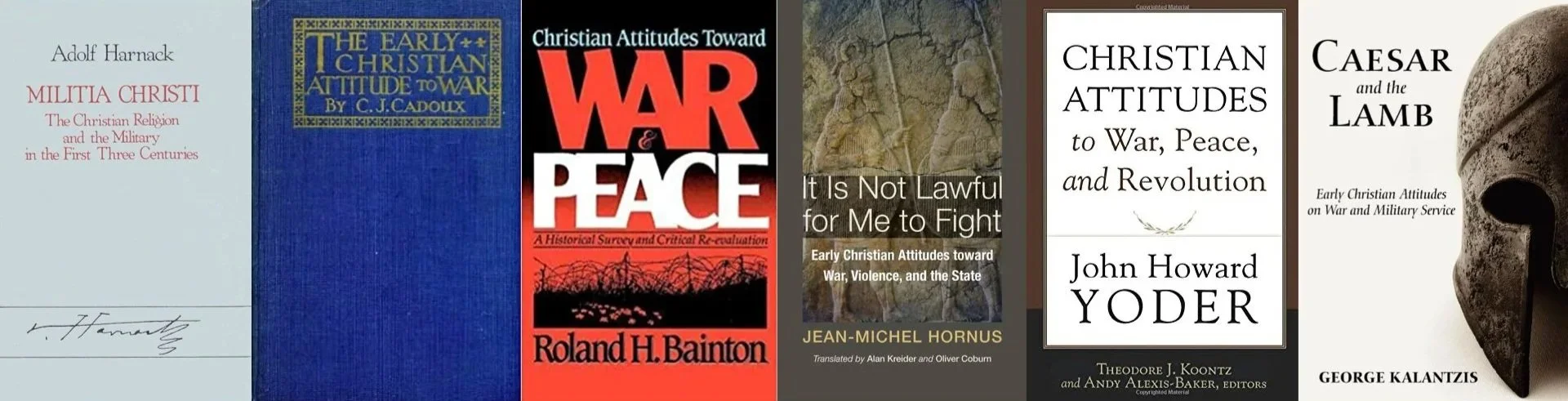
This is not a gotcha. It's a structural observation. In the United States, college students and ministers have historically been exempt from conscription. If you enter college young and pursue ordination, you can pass through your entire adult life without having to make a serious decision about military service. The end of the draft in 1973 made this even easier for everyone downstream. The burden of service fell on people for whom it represented the best of a limited set of options. The people it didn't fall on became, disproportionately, the scholars.
The result is an intellectually homogeneous field producing confident claims about early Christian attitudes toward something most of its leading voices have never had to think about in personal, institutional, or morally embodied terms. When Richard Hays writes that "the place of the soldier within the church can only be seen as anomalous," or when George Kalantzis publishes that "what is asked of soldiers is to kill," they are not drawing on lived engagement with military culture. They are extrapolating from text through their own ideology.
I know what I was told my primary responsibility was—in boot camp. The word "kill" showed up once, in an authorized hyperbole meant to reset the civilian psychology of a room full of eighteen-year-olds. That's not what the Army does. That's not what armies have ever primarily done. Believing otherwise is like reading the Left Behind series as straight journalism about eschatology.
The mechanism for self-correction doesn't exist in most academic theology circles, and I watched it firsthand. At a 2012 Society of Christian Ethics conference on war, only professors and PhD students could submit papers. I sat in the audience. I found one other veteran in attendance; we commiserated at dinner. He wasn't going to go on the record—tenure was still ahead of him. This ⬆️ is how the echo chamber maintains itself.
None of this makes those scholars dishonest. It makes them human. We all reason from where we stand. But it does mean their claims about "the earliest attitudes" toward Christian soldiers should be received with considerably more skepticism than they typically have been—not because their pacifist commitments are wrong, but because their “evidence” is filtered through a monoculture.
Toxic pacifists George Kalantzis and Stanley Hauerwas chose liturgical theater over academic rigor.
When you read the New Testament with actual military experience, or even just with genuine curiosity about what soldiers do all day, something different emerges. You see men doing their jobs: keeping order, protecting people, navigating dual loyalties, asking religious figures what they should do with their lives. You see a community that baptized them, marveled at their faith, and built its first Gentile church inside their family.
The earliest attitudes were not ambivalent toward soldiers, they emerged from within their ranks. That's what the text says. The ambivalence came later, from people who didn't have to choose, other than to look the other way.