GruntGod 2.5.1: Sergeant, Top, or Master?
Reading Roman Rank in the New Testament
This is drawn from my revision of God Is a Grunt—material that didn't make the primary-audience cut but that I can't bring myself to bury in footnotes.
The New Testament authors didn't know military rank.
That sentence should matter more than it does to biblical scholars. When Luke or Matthew writes "centurion," they're using the Greek word hekatontarchēs as a catch-all, the way a civilian might call anyone in a uniform a "soldier." In reality, the Roman military had a grade structure as layered as anything the U.S. Army uses today, and conflating the ranks produces interpretive errors that have gone mostly unexamined.
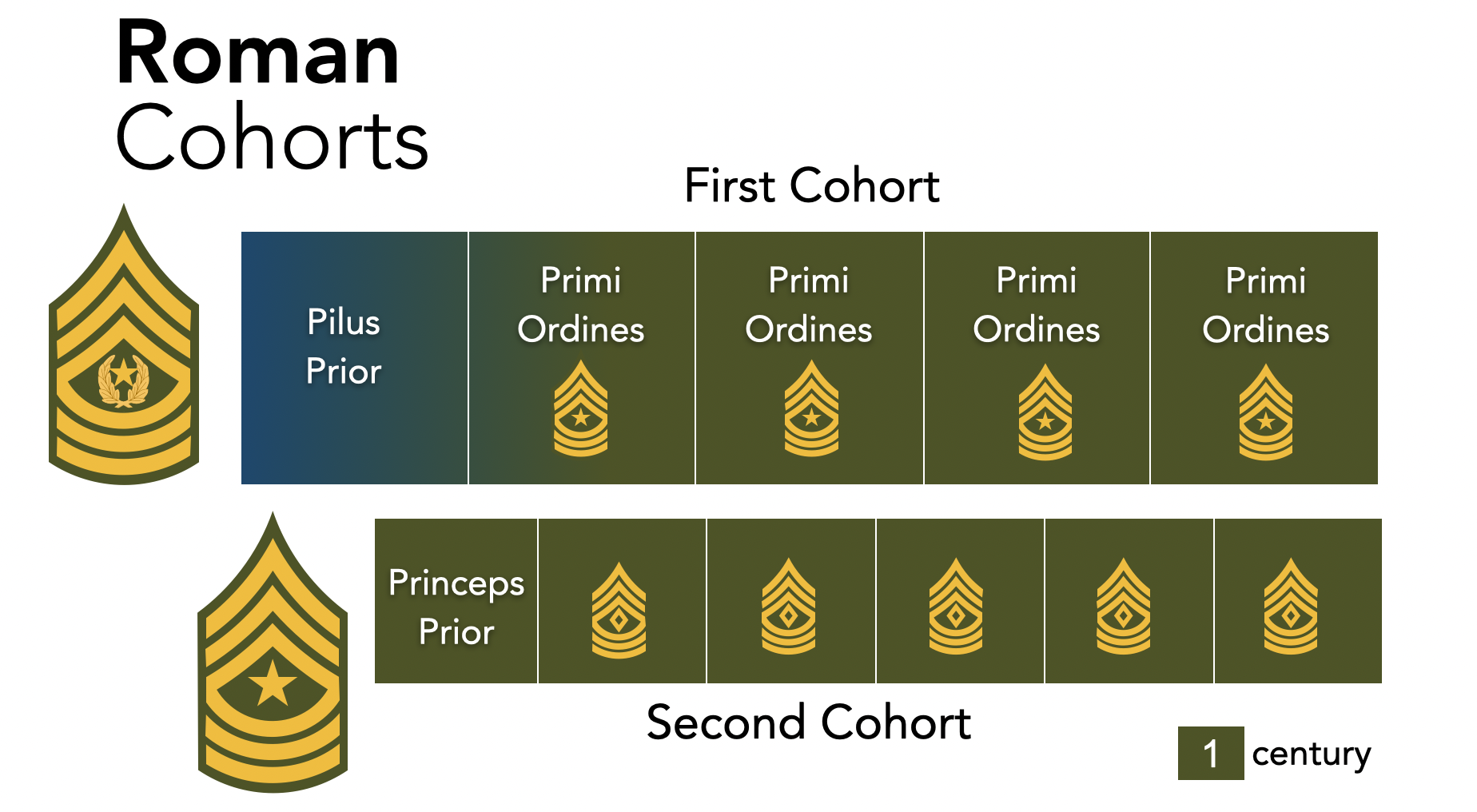
Here is the basic structure. The base unit was the century—nominally one hundred soldiers, in practice often fewer. Every century was led by a centurion, hence the name, which at that level is equivalent to a first sergeant (1SG): an experienced NCO whose entire responsibility was his hundred soldiers. Six centuries formed a cohort of roughly six hundred. The senior centurion of those six was called in Latin the princeps prior, roughly equivalent to a master sergeant (MSG)—he commanded one century but held authority over all six hundred. Ten cohorts formed a legion of about six thousand. The senior centurion of the entire legion was the primus pilus or pilus prior, equivalent to a command sergeant major (CSM): the senior enlisted advisor to the commanding officer, the "brains from the bottom" whose credibility ran the organization's daily life.
Commissioned officers were tribuni—young men in their twenties from the equestrian or senatorial class, mostly doing administrative work while preparing for political careers. The New Testament lumps them all under chiliarchos, "head of a thousand," which corresponds to no actual Roman unit size. In practice, you had five junior "narrow stripe" tribunes (think Army captains) and one senior "broad stripe" tribune (think Army colonel) concentrated in a legion's headquarters element. The legatus, the commanding general, was politically appointed and rarely a military professional.
Why does this matter for reading the New Testament? Two reasons.
First, it affects how we read social status. When Luke describes the centurion in Luke 7 as having built a synagogue and commanding soldiers, the grade of centurion matters enormously. As part of Antipas's Herodian numeri—a smaller regional force where proportionate rank carries more weight—this man isn't a mid-grade NCO. He's closer to a company commander, a captain, with significant wealth and court connections. That’s why I call him Captain Marvel. Calling him a "centurion" the way we might say "corporal" undersells him dramatically. He is not an outsider making an improbable religious cameo. He is a powerful regional figure choosing humility.
Second, it exposes how civilian writers—then and now—handle military culture. The gospel authors weren't soldiers. Neither are most biblical scholars. When you read NT scholarship on "the centurion" as though all centurions are interchangeable, you're watching civilians do what civilians have always done with military culture: flatten it, simplify it, mistake the jargon for the reality. The same scholars who argue soldiers are "anomalous" in the New Testament haven't thought hard enough about what kind of soldiers they actually were, because they've never had to.
The best modern resource on this remains Christopher Zeichmann's The Roman Army and the New Testament. He does the historian's work of situating these figures in their actual institutional context rather than treating them as props for theological argument. If you're doing serious work on military figures in the Gospels and Acts, start there.
When the New Testament says "centurion," it might mean a first sergeant. Or a master sergeant. Or a command sergeant major. The difference matters, both for reading the text faithfully and for understanding why these men—men the early church decided to include and not exclude—made the choices they made.