GruntGod 2.5.3: The Most Overlooked Convert
This is drawn from my revision of God Is a Grunt. Sergius Paulus gets about four sentences in most commentaries. He deserves more.
Cornelius gets Acts 10 and 11—two full chapters, the first Gentile baptism, a debate in Jerusalem, a paradigm-shifting vision. He is, rightly, the icon of the Christian military convert.
Sergius Paulus gets eight verses. And almost no one talks about him.
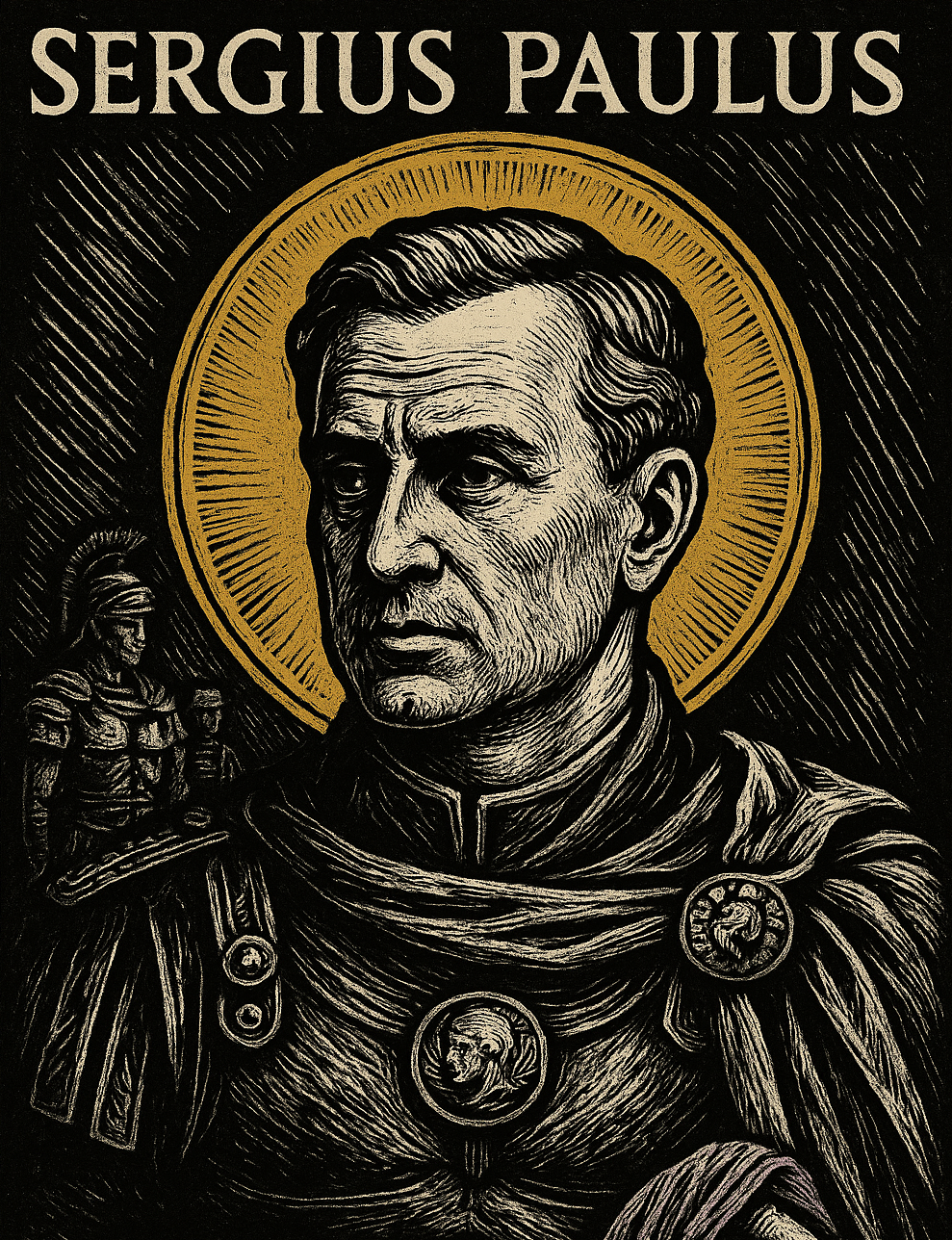
Acts 13:4–12 describes the first missionary journey's landing in Cyprus, a quiet Roman island province that was, by the political logic of the empire, a dead end posting. Proconsul there meant other aristocrats didn't trust you. You had class without friends, power without might. Cyprus was the kind of assignment you got when you needed to be managed.
Sergius Paulus had already been circling Judaism through a magician named Elymas before Psaul and Barnabas arrived. When Psaul blinds Elymas in a confrontation, the governor sees what the gospel actually does and believes. Luke's language is spare but unambiguous: "When the proconsul saw what had happened, he believed, for he was astonished at the teaching about the Lord" (Acts 13:12).
Paulus is the governor of a Roman province. He commands whatever military presence the island has. He is, without question, the single most politically powerful person to be converted to the faith anywhere in the New Testament.
And he gets eight verses.
Why? A few possibilities, none fully satisfying. First, Luke's attention in Acts is following Psaul, not cataloguing converts. Paulus is a data point on the missionary itinerary, not its subject. Second, and more interesting: Luke notes that when Saul confronts Elymas, he is "also known as Paul" (Acts 13:9)—the only time his Roman name is introduced. Some scholars have speculated that Psaul adopted his Roman name after the proconsul, either as a tribute or because Paulus was already his Roman cognomen. If true, the conversion of Sergius Paulus sits at the hinge moment where the Jewish rabbi Saul becomes the Roman apostle P(s)aul. That's significant. It's been largely ignored.
Third, he's not a grunt—and this book is about grunts. Paulus is a political appointee, not a soldier by trade. He's in the military apparatus by position rather than by vocation. That distinction matters for my project, which is why his section is brief in the main chapter.
But for anyone doing serious theological work on power and conversion in Acts, Sergius Paulus is a problem that hasn't been adequately solved. What happens when the most powerful man in the room believes? How does the church deal with a convert who commands soldiers? What does it mean for the gospel's trajectory that Psaul's first named high-status convert is a Roman governor?
I don't have complete answers. But I'm suspicious of a scholarship that didn't find the question interesting enough to ask.