GruntGod 2.14.5: Civil Rights Math
Why Military Families Keep Losing Ground
Thanks to decades of civil rights advocacy, federal law now protects Americans from discrimination on the basis of race, color, religion, sex, national origin, age, sexual orientation, gender expression, citizenship, family size and status, disability, and genetic information. Access to employment, education, housing, and public accommodation are all covered, backed by real enforcement infrastructure and real case law.
There's a comparison I cut from the chapter because it needed room to breathe rather than a single dense paragraph. Roughly 29 percent of Americans live with a disability, according to the CDC. About 15 percent identify as Black or African American, per the 2020 Census.* As for gender minorities, Gallup reports that they constitute just over nine percent of Americans, a number that has been climbing steadily for over a decade. Each of these communities has seen real, if incomplete, legal progress, propelled in no small part by the fact that they represent a large and growing share of the electorate and the workforce.
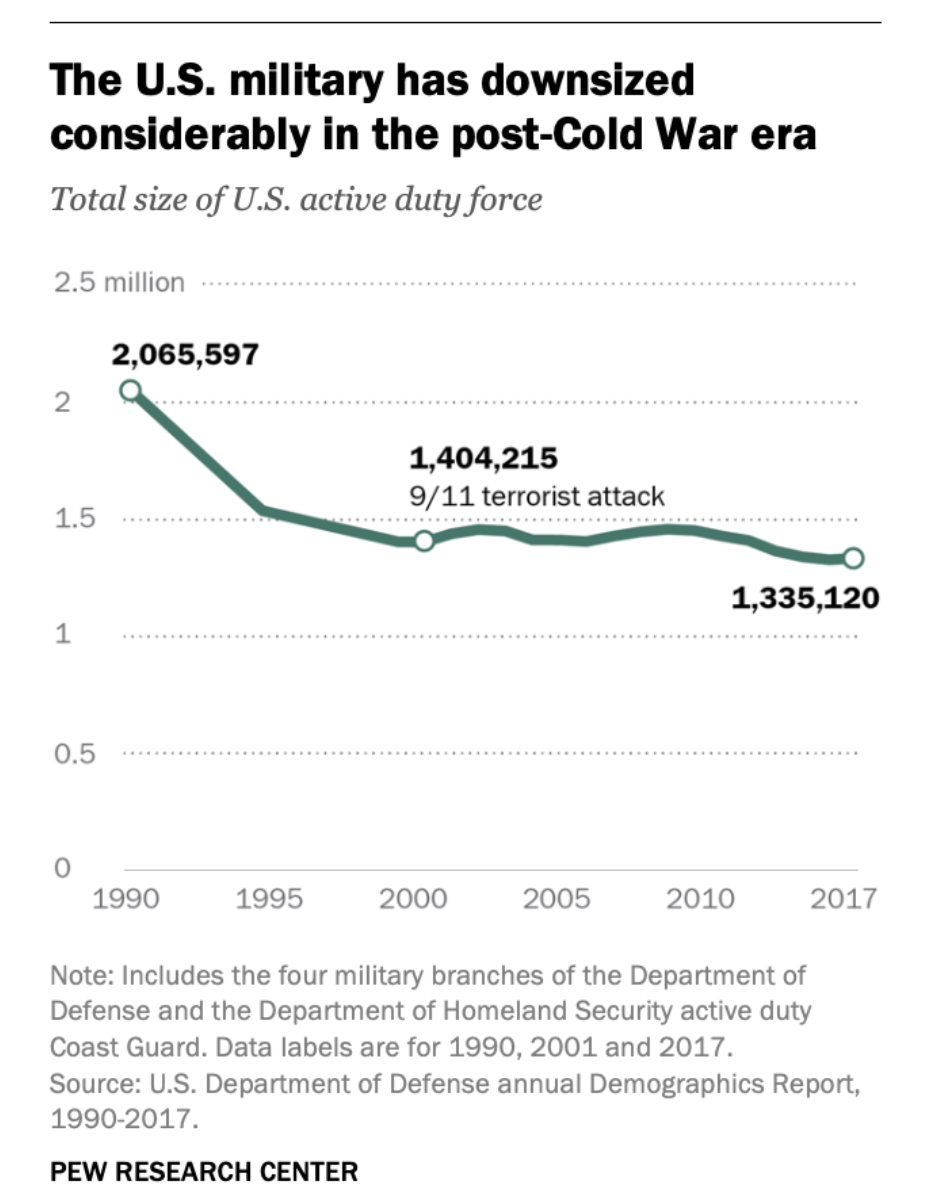
Click for Pew Center source.
The entire military community, made up of roughly 18 million veterans plus less than 4.3 million active-duty service members and dependents, comes to less than 8 percent of the total U.S. population. And unlike every other protected category above, that number isn't growing. It's shrinking, and has been for decades, as the all-volunteer force becomes a smaller and smaller share of American life.
This is the uncomfortable math: legal protection in this country tends to track political and demographic weight. Groups that are large, growing, and civically organized get real enforcement machinery built around their protections, even when that machinery takes decades to arrive. Military families are small, shrinking, and (despite the ceremonial reverence Americans claim to hold for them) do not have equivalent machinery. VEVRAA has no teeth. Section 1389 has teeth nobody uses. The trajectory is not toward parity. It's away from it.
I don't raise this to argue that other groups' protections are somehow oversized or that this is some kind of zero-sum contest for sympathy, it isn't, and framing it that way would betray the whole argument of my work. I raise it because a body that is 8 percent of the population and shrinking will never win this fight through political weight alone. If military families are going to get the same seriousness of protection that other Americans now take for granted, it will have to come from somewhere other than electoral math. It will have to come from civilian institutions, including churches, that choose to advocate for a shrinking minority precisely because it's right, not because it's popular or profitable to do so.
That's not a policy proposal. It's a challenge to the church specifically, since a body that claims to care about justice for the marginalized cannot let military families fall out of that category just because their numbers are going the wrong direction. More on what that could look like practically is something I'm actively working through at pewpewhq.com and through the Hospitallers of St. Martin — but the math above is the reason the question is urgent in the first place.
*46,936,733 Americans self-reported as “Black or African American” out of a total population of 308,745,538 in 2020.