GruntGod 2.14.2: VEVRAA — The Law That Isn't a Law
*Honest caveat up front: the exact size of the racial disparity discussed below is something I'm still reconciling against my own earlier research, and I'll update this post once that's settled. The direction of the disparity isn't in question. The precise multiplier is.
The Vietnam Era Veterans' Readjustment Assistance Act (VEVRAA) is the law Congress passed in the wake of Ron Kovic's very public humiliation at the 1972 Republican National Convention. On paper, it guarantees veterans equal opportunity in employment. In practice, a federal appellate court has already told us, in writing, exactly what VEVRAA is worth. In Greer v. Chao, a Vietnam veteran asked the Department of Labor to actually enforce the statute on his behalf. The court dismissed the case. The relevant line, from the opinion itself, is that the statutory language “leaves us with no law to apply.” That's a federal court telling a veteran, essentially: this law exists, but there's nothing here we can actually make anyone do.
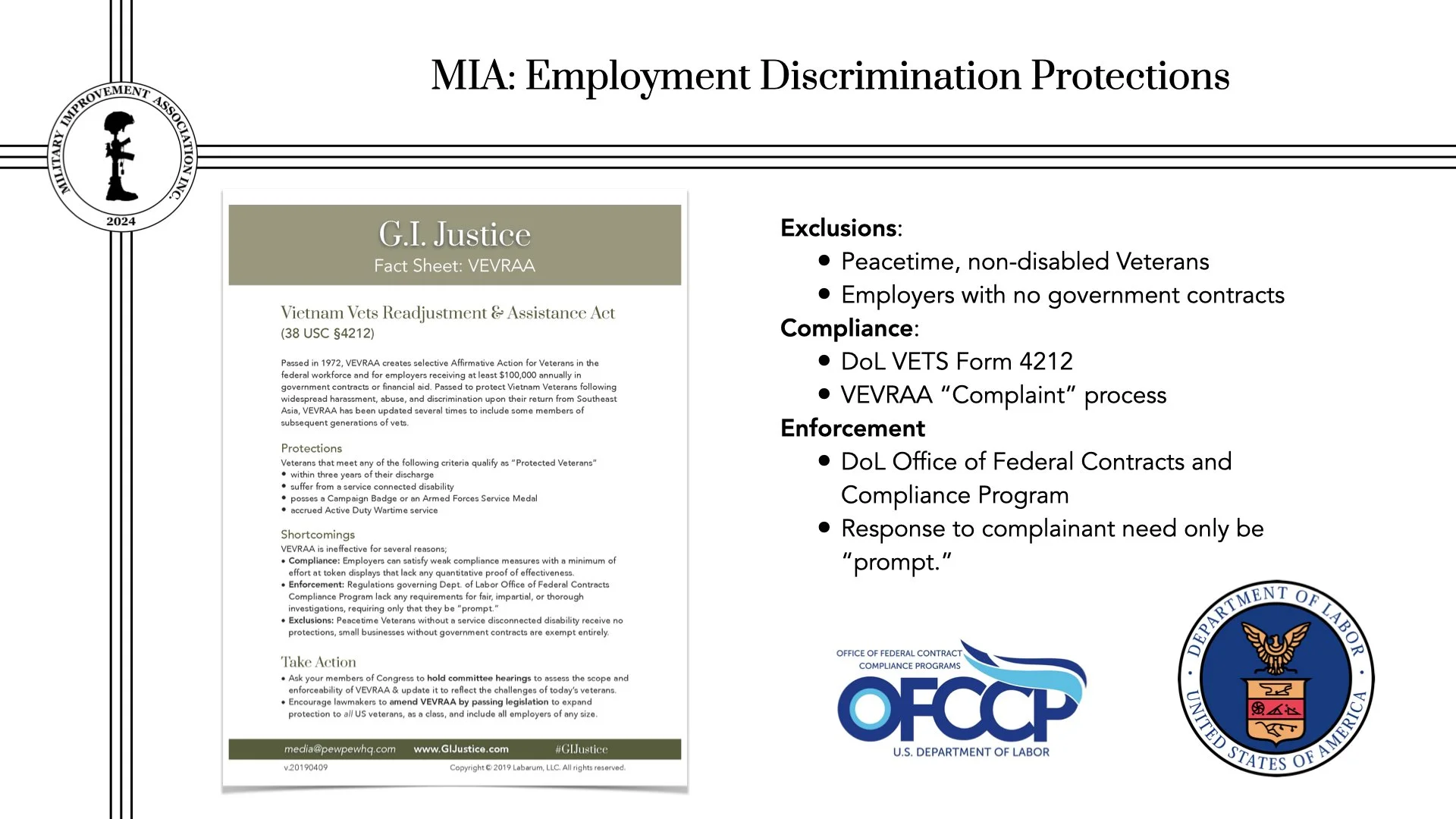
To view the entire presentation, click for source.
I found out how true that was the hard way. After Duke University's internal process on my discrimination complaint amounted to nothing, I filed with the Department of Labor, believing VEVRAA existed for exactly this situation. It didn't help. What I didn't expect was what I'd find when I started digging into why.
Under 38 USC 4212(c), the Department of Labor is required to report to Congress every year on the number of VEVRAA complaints filed, the actions taken, and the resolutions reached. The subagency responsible, the Veterans' Employment and Training Service (VETS), has a documented pattern of omitting exactly this required information from its annual reports — the same reports that open by citing their own statutory obligation to include it. When I raised this directly with the director of compliance at VETS, his response was to thank me for my service and ask me, in so many words, to leave him alone.
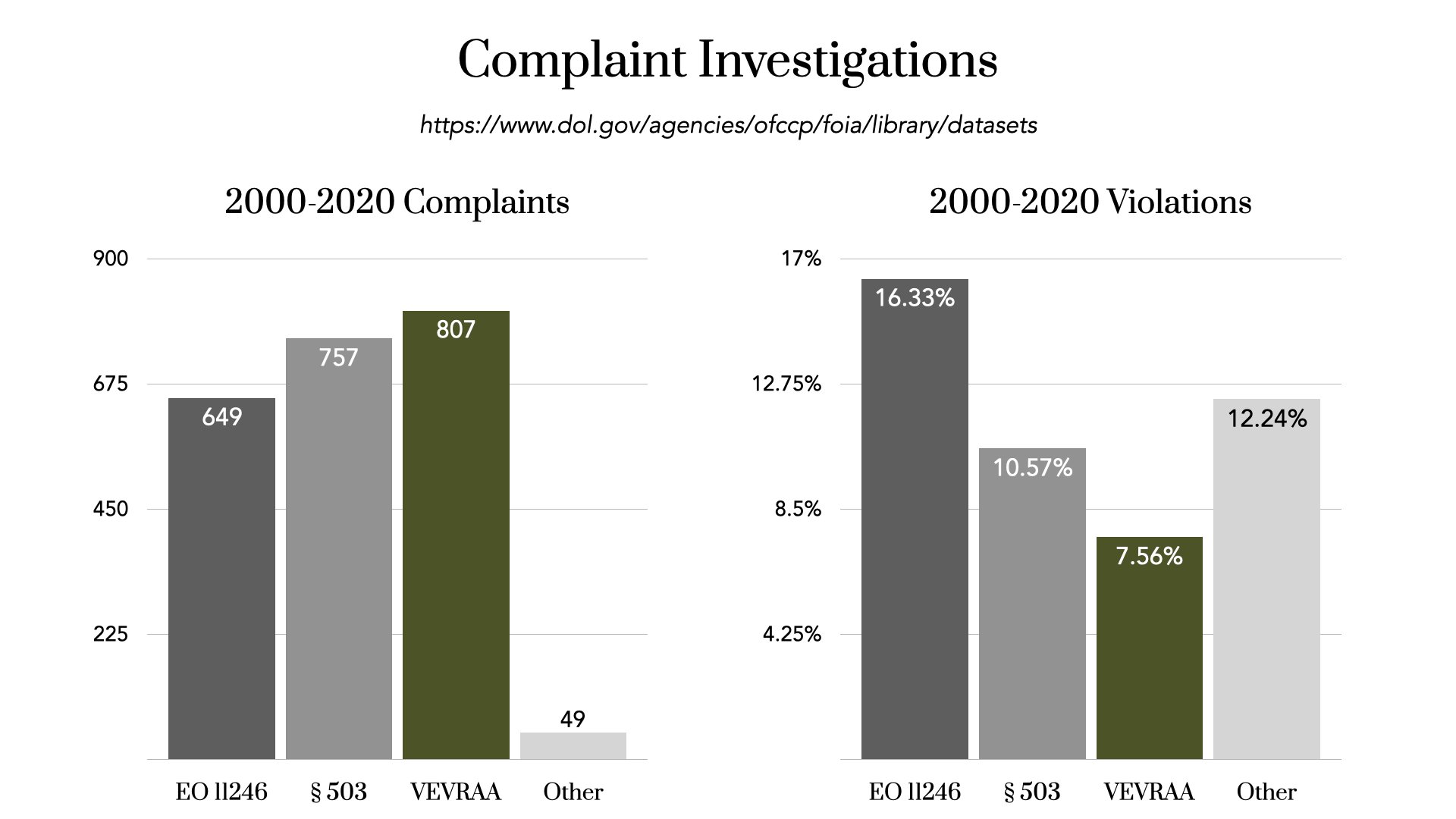
The data that does exist is not encouraging. VEVRAA complaints get turned away at a dramatically higher rate than other categories of federal statutory complaint — by my own accounting, as much as four times as often. And the complaints that do get investigated split badly along racial lines: complaints filed on the basis of being White return a finding of merit far more often than complaints filed on the basis of being Black. I want to be precise about a number here rather than confident about one I haven't re-verified, so I'll simply say: whatever the exact ratio turns out to be once I've reconciled my sources, it isn't close to parity, and it deserves its own full accounting rather than a single sentence in a chapter about something else.
Here's the theological stake, since this is still a chapter of a book about virtue, not just a policy complaint. A law that exists only on paper is a kind of institutional hupocrisy — a performance of care with no follow-through. The federal government performed “we take care of our veterans” in 1974 with VEVRAA's passage, the same way plenty of churches perform “we support our troops” with a flag in the sanctuary and nothing behind it. Ignatius had a word for people who do that. So do grunts. The word isn't flattering either way.
This is exactly the kind of institutional accountability work I try to keep visible at gijustice.com, and I'll link the underlying FOIA documentation there once I've finished reconciling the enforcement numbers properly.