GruntGod 2.12.5: Fellow Soldiers
What 2 Timothy 2:4 Actually Says
This is drawn from the revision of the Ignatius chapter in the second edition of God Is a Grunt.
Last post in this run pulled from Ignatius chapter revisions for God Is a Grunt, second edition. If you've read the first four, you've got the full picture the book chapter only has room to summarize: the Jewish prayer clock behind Christian daily prayer, the real meaning of service, the chivalric romance that gave Ignatius his spiritual vocabulary, and the crusading corruption he walked away from. This post is where all four threads land.

In 1534, Ignatius and a handful of followers in Paris (including Francis Xavier, whose own family had fought against Ignatius at Pamplona) decided to formalize what they'd been doing informally for years. They needed a name. What they picked was Compañía de Jesús; the Company of [Joshua].
Modern readers, including a lot of Jesuits, tend to hear "company" the way we use it now; a companionable group, friends who keep each other company. That reading isn't wrong exactly, but it's incomplete in a way that erases the point. Compañía in sixteenth-century Spanish had a live military sense that's mostly drained out of the English cognate: campaña militar, a military campaign team; a compañía was a company of soldiers, a standard unit of organization, the same word you'd use for the outfit a Spanish soldier like Ignatius himself had served in at Pamplona. When Ignatius named his religious order, he wasn't picking a soft, sociable word. He was naming them a unit.
The textual anchor for this is 2 Timothy 2:4: "No one serving in the army gets entangled in everyday affairs; the soldier's aim is to please the enlisting officer." The Greek verb is strateuomai (G4754) — to serve as a soldier, to be enrolled in an army. The Reina-Valera Bible, the Spanish translation Ignatius and his companions would have known, renders that military sense explicitly with campaña militar. This is the text the Compañía de Jesús is named after. It is not an accident, and it is not a metaphor doing decorative work. Saul is telling Timothy that ministry requires the same undivided loyalty a soldier owes his commanding officer, and Ignatius took that comparison literally enough to build an entire religious order's identity on it.
Here's a translation choice I think the Company-of-Jesus scholarship undersells: the New Testament actually has a more precise word available for what Ignatius's followers were to each other, and it's not the one that ended up in most English Bibles. Sysstratiotes (G4961) means, literally, "fellow soldier" — a co-combatant, someone serving in the same unit rather than merely a companion in the loose sense. Psaul uses it exactly twice: for Epaphroditus in Philippians 2:25, and for Archippus in Philemon 1:2. Both times, English translations soften it to "fellow worker" or "fellow soldier" inconsistently depending on the edition, which quietly erases the military specificity Saul reached for on purpose. If Ignatius had drafted the order's founding documents in Latin with full technical precision, sysstratiotes — not the vaguer "companions" — is the word that actually describes what he meant Jesuits to be to one another.
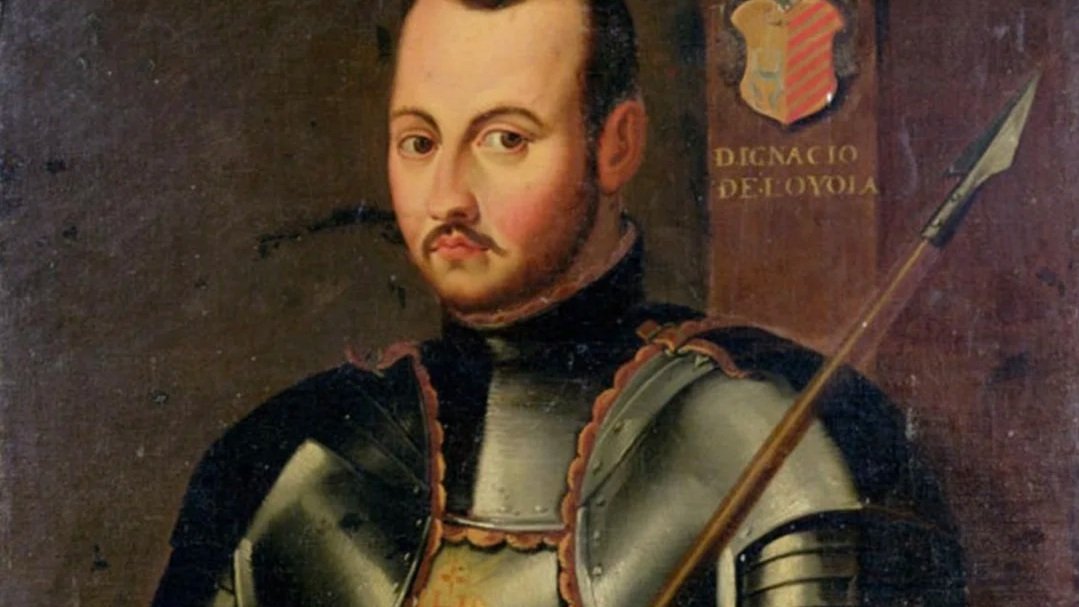
We know Ignatius wasn't reaching for vague fellowship, because we have his own language. In 1539, drafting the five founding chapters that would become the order's charter, he addressed the document to "all who desire to serve as a soldier of God beneath the banner of the Cross in our Society." He wrote this in Spanish, not Latin, meaning the word underneath "Society" in that sentence was almost certainly compaña, the same military term Psaul's translators reached for in Philippians. The founding vocabulary of the Jesuits is martial from top to bottom, not merely inspired by military metaphor but built directly out of it, by a man who had actually served and actually bled before he ever picked up the Exercises.
Ignatius didn't discover a clever metaphor connecting soldiering to sainthood. He discovered (the hard way, after a cannonball, after two books that weren't the pulp fiction he'd asked for, after a night's vigil that mimicked the very knight-fiction that formed him) that the New Testament had been describing discipleship in explicitly military terms since Psaul first used strateuomai and sysstratiotes to describe what ministry actually costs. Ignatius didn't civilianize his soldiering when he became a priest. He just changed which army he was reporting to. Same discipline. Same chain of command. New mission.
That's the thesis of the whole book, honestly, just proven out one more time in one more life: God was never asking soldiers to become something other than soldiers. He was asking them to figure out who they were actually reporting to.