GruntGod 2.12.4: Crusade by Any Other Name
This is drawn from the revision of the Ignatius chapter in the second edition of God Is a Grunt.
This one is historical context I cut from the military-family version of the chapter because it slows down a story that needs to move — but if you want to understand why Ignatius's world was primed to produce someone who'd walk away from knighthood entirely, you need this piece.
By the time Iñigo López de Oñaz y Loyola was born in 1491, in the kingdom of Navarre, the crusading project that had defined "holy war" for Western Christendom for four centuries was already dead, and everyone knew it. The last serious attempt to hold the Holy Land had collapsed in the 1270s. The Portuguese Crusade of 1481 — a full decade before Ignatius's birth — was the final gasp of the model, and even that was already something different from what it had started as.
Here's the part that matters for understanding the corruption Ignatius would later react against: when direct conquest of Jerusalem stopped being viable, the papacy didn't retire the crusading apparatus. It repurposed it. A new term emerges out of Navarre specifically — Ignatius's home kingdom — for holy war waged against other Christians rather than Muslims: crozada. The word survives in the 1213 epic poem Canso de la crozada, chronicling the Albigensian Crusade against the Cathars of southern France, a campaign whose target wasn't a foreign army holding sacred territory but a rival Christian sect the Church had decided to eliminate by force.
This is not a minor semantic shift. The entire theological architecture of crusade (the promise of indulgence, the moral logic of righteous violence, the recruitment machinery) had been built to authorize war against a specific external enemy defined by religious difference. Once that machinery got turned inward, against fellow Christians, the Church needed the population to accept that the same violence, the same spiritual rewards, and the same claim to God's endorsement applied regardless of who was on the other end of the sword. Crozada is the linguistic residue of that argument succeeding. And once it had succeeded once, there was no obvious reason for the Papal States to ever fully retire the tool. The Crusades, under one label or another, ground on for roughly two more centuries after crozada entered the vocabulary — not because the original mission (retake Jerusalem) remained viable, but because the machinery had proven too useful, and too profitable, to dismantle.
I don't think it's a coincidence that the word for "we can call this holy war too" comes out of the exact region that produced a young nobleman who would spend the first thirty years of his life absolutely convinced that military glory and divine favor were the same thing — and then spend the rest of his life trying to work out how much of that conviction had ever been true.
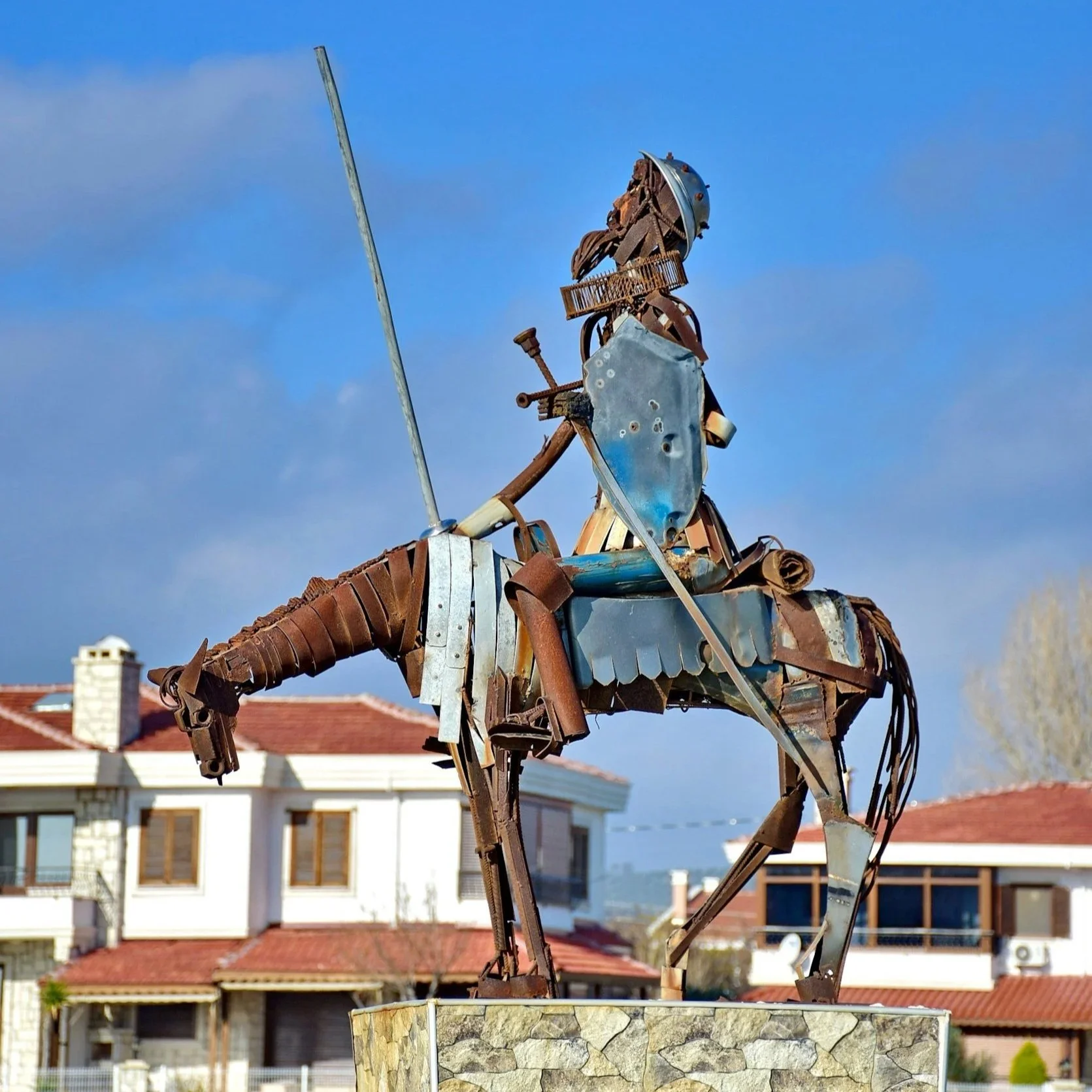
By the early sixteenth century, the gap between the Church's official rhetoric about redemptive violence and the Church's actual, visible behavior had become impossible for an attentive layperson to ignore. This is the world Cervantes would later satirize through Don Quixote — a minor nobleman so committed to an outdated chivalric fantasy that he can no longer distinguish windmills from giants. But Quixote is a comedy because its protagonist never has a Pamplona. He never gets hurt badly enough, in a war stupid enough, run by people corrupt enough, to force the question. Ignatius did. A cannonball took that decision out of his hands and put him flat on his back with nothing to read but a Life of Christ and a book of saints' biographies, at the exact historical moment when the crusading ideology he'd been raised on had run out of intellectual and moral credibility.

Ignatius's later insistence that "God's knights do not intentionally shed blood" — his refusal, on the road to Montserrat, to run down the Muslim traveler who'd offended his honor — isn't just personal piety. It's a direct rejection of the crozada logic he grew up inside of, the logic that said righteous violence against a doctrinal opponent was not just permissible but honorable. He'd been raised inside a system built to make killing feel like duty. At the literal fork in the road, he chose not to.
That refusal is the hinge the rest of his life turns on. More on what he built instead in the next post.