GruntGod 2.8.1: What ‘Monk’ Actually Means
(And Why It’s Not What You Think)
This is drawn from the revision of the Pachomius chapter in the second edition of God Is a Grunt.
The word we translate ‘monk’ has a problem: it points in the wrong direction. Most people hear ‘monk’ and think isolation — someone alone in a cell, praying away from the world. That reading comes from the Greek monos, ‘single or alone,’ which was indeed used to name the individual cells monks occupied. But the Greeks called these people monachos, which means ‘single’ in a different sense: celibate. One per bed. Non-procreating. The difference between ‘lives alone’ and ‘sleeps alone’ is significant, especially when you’re trying to understand a movement that began not as withdrawal but as witness.

Before the Greek word stuck, Syriac Christians had their own title for the especially devout: Ihidaya. It’s the Syriac equivalent of the Greek monogenes — ‘only begotten one,’ the same word John’s Gospel uses for Joshua+ in 1:18. The non-needing, non-procreating ones modeled themselves not on isolation but on the Son who had no earthly family to retreat to, nowhere to go but into the world he came to save. That’s a completely different spiritual logic than the desert hermit.
The most direct form of intentional holiness in the Hebrew Bible is the Nazirite vow, described in Numbers 6. Three prohibitions:
no alcohol (extending all the way to grapes and grapevines),
no contact with a human corpse, and
no haircut.
The hair was the visible sign — a ‘consecrated head,’ r’os nezer in Hebrew, announcing to anyone who looked that this person had made a vow. To end the vow, you went to the temple, made three offerings with the priest’s assistance, shaved your head over the fire, and then — finally — had a drink. Because who wouldn’t need one after eating hair-smoked ram chop?
Nazirite vows were available to men and women alike, usually time-limited rather than lifelong, and required only a public declaration to begin. In the New Testament, Paul takes what appears to be a Nazirite vow in Acts 18 (‘he had his hair cut, for he was under a vow’) and is later urged by James to join four other believers in completing their vows in Jerusalem — explicitly as evidence that the Christian movement is still Jewish. Nazirite practice is being used as apologetics.
The family of Jesus seems to have had a particular affinity for Nazirite-adjacent practices. John the Baptist was under a prenatal prohibition on ‘wine or strong drink’ (Luke 1:15) — Gabriel implementing something like a Nazirite vow before John was even born. Jesus’ brother James ‘drank no wine or other intoxicating liquor, nor did he eat flesh; no razor came upon his head,’ according to Hegesippus writing before 180 CE. And Nazareth itself — a town that appears nowhere in the historical record before the Gospels — has a name that is a cognate of ‘Nazirite,’ linked by Matthew to the Samson prophecy in Judges 13.
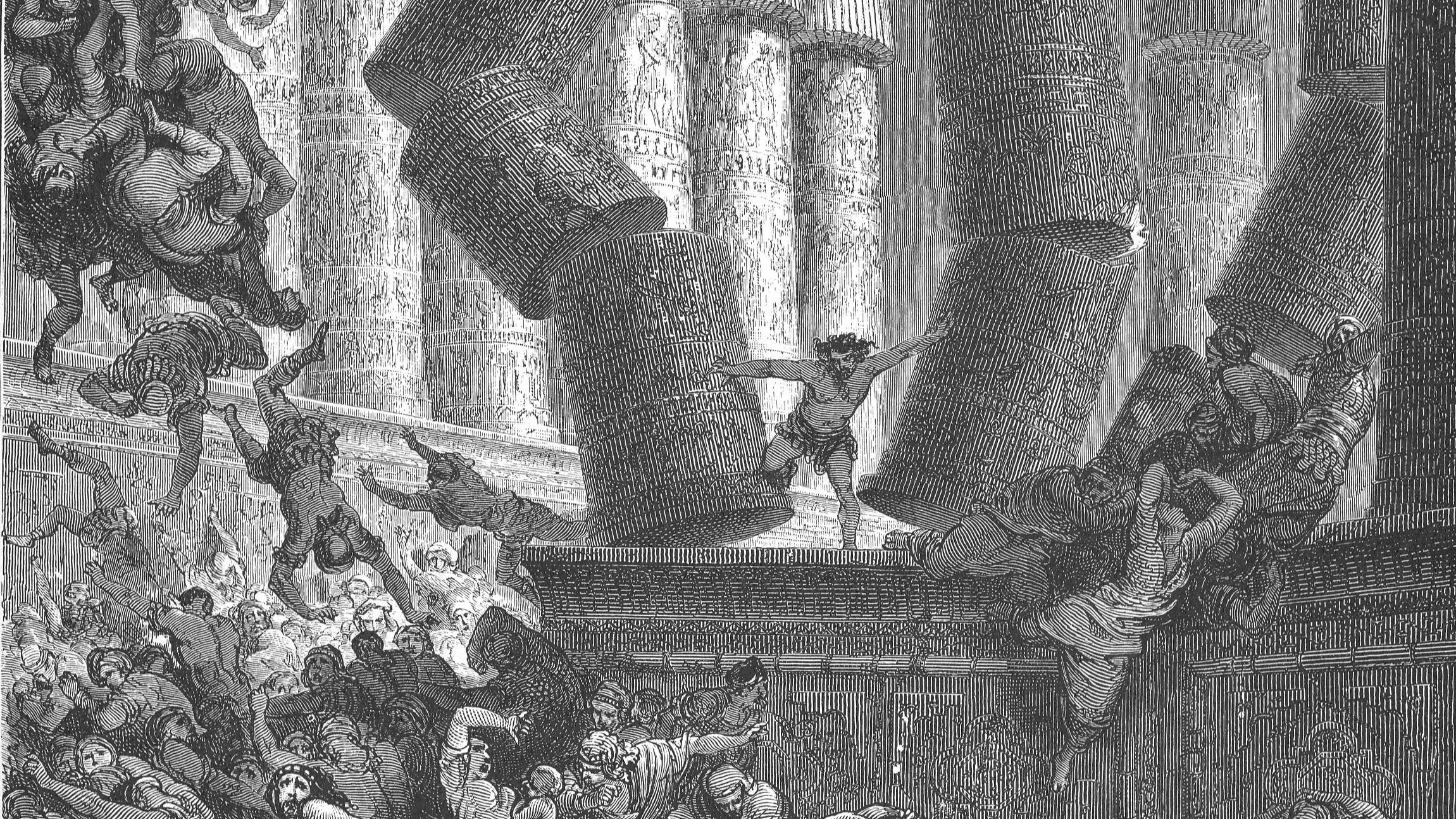
Detail of The Death of Samson by Gustave Dore
Was Christ a Nazirite? No. He drank wine and touched the dead body of Jairus’ daughter. But he emerged from a family culture saturated with Nazirite-ish piety — standing out from the crowd as a public sign of devotion rather than standing apart in private isolation. That distinction — standing out versus standing apart — is the theological hinge of the entire monastic tradition, and it’s what Pachomius got right that the hermits got wrong.