GruntGod 2.7.2: The Thundering Legion
The Problem with "The Early Church Was Anti-Military"
This is drawn from the revision of the George chapter in the second edition of God Is a Grunt.
One of the most persistent claims in pacifist readings of early Christian history is that the early church was uniformly opposed to military service. Some of the evidence for this is real: certain early fathers, Tertullian especially, wrote against Christians bearing arms. The tradition of pre-baptismal renunciation of certain professions, including soldier, existed in some communities.
But the evidence cuts the other way too, and the counter-evidence tends to get ignored.
In 173 CE — well before any Roman emperor formally persecuted Christians — a Roman legion was surrounded by barbarians on the Danube frontier. What saved them, according to two separate ancient sources, was the prayers of their Christian members. Eusebius records the story in his Ecclesiastical History (bk. 5, chap. 5), but the more interesting source is Cassius Dio — a non-Christian Roman historian whose account of the same event appears in his Roman History (bk. 72, chap. 8). Dio credits the rescue not to a god but to an Egyptian magician accompanying the army. The divergence in attribution is exactly what you'd expect from two writers with different theological priors describing the same strange weather event. What both accounts agree on: the Legio XII Fulminata, the so-called "Thundering Legion," was saved by something unusual, and Christians in the legion were part of the story.
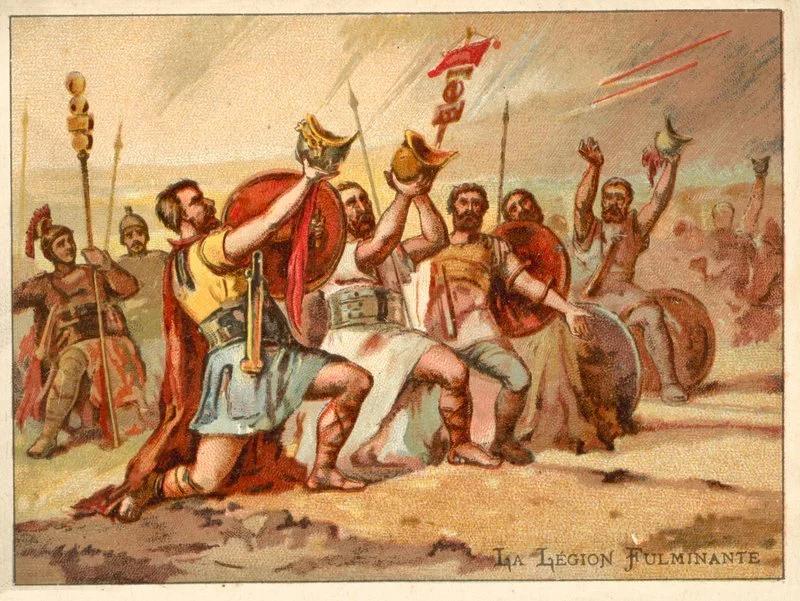
The point is not which explanation is correct. The point is that Christians were present and openly identified in a Roman legion in 173 CE, at a time when the most systematic persecution had not yet begun. If the early church had a coherent anti-military stance, it was not the only stance, and it was not preventing Christians from enlisting.
By the time Diocletian's Great Persecution began in 303, Christians were in the Praetorian Guard. The persecution "began with the brethren in the army" (Eusebius, Ecclesiastical History, bk. 8, chap. 1.8) — because that's where they were. Soldiers were first to suffer because those lovable scoundrels were first on the ground, baptized beside Christ in Luke 3.
The "early church was anti-military" reading is not entirely wrong. It's just not the whole story. And the parts that get left out tend to be the parts where soldiers are present, faithful, and dying.