GruntGod 2.13.5: (Black) GIs Wrote the Legal Playbook
From Irene Morgan to Brown v. Board
This is drawn from the revision of the Ralph chapter in the second edition of God Is a Grunt.
Rosa Parks didn't start the fight over segregated buses. She closed a legal campaign that Black servicemembers and defense workers had been running for over a decade, and understanding how that campaign actually worked (the specific legal mechanism, not just the moral outrage) matters for anyone trying to understand how civil rights law developed. I compressed this history down to a few sentences in the book chapter. Here's the fuller argument.
Irene Morgan worked at the Glenn L. Martin defense plant in Baltimore, building B-26 Marauder bombers, when she refused to give up her bus seat to a White passenger in July 1944. She fought her segregation charge all the way to the Supreme Court, and on June 3, 1946, the Court ruled in her favor in Morgan v. Virginia. But the legal reasoning mattered more than the headline: the Court didn't rule that segregated seating was morally wrong. It ruled that Virginia's segregation law, applied to interstate travel, violated the Constitution's interstate commerce clause; Congress, not individual states, had authority over interstate bus routes, and a patchwork of conflicting state segregation laws created exactly the kind of burden on interstate commerce the Constitution was meant to prevent.
That's a narrower ruling than it sounds like, and the narrowness created a loophole almost immediately. The wording could be read to apply only to direct routes running to and from integrated stations in the North. A terminal in the segregated South, without a direct connection north of the state line, could plausibly claim exemption. That's exactly the loophole Staff Sergeant Hosea Williams ran into in Americus, Georgia, when he was nearly beaten to death for reaching through a Whites-only terminal door. It's also the loophole that snagged Private First Class Sarah Keys.
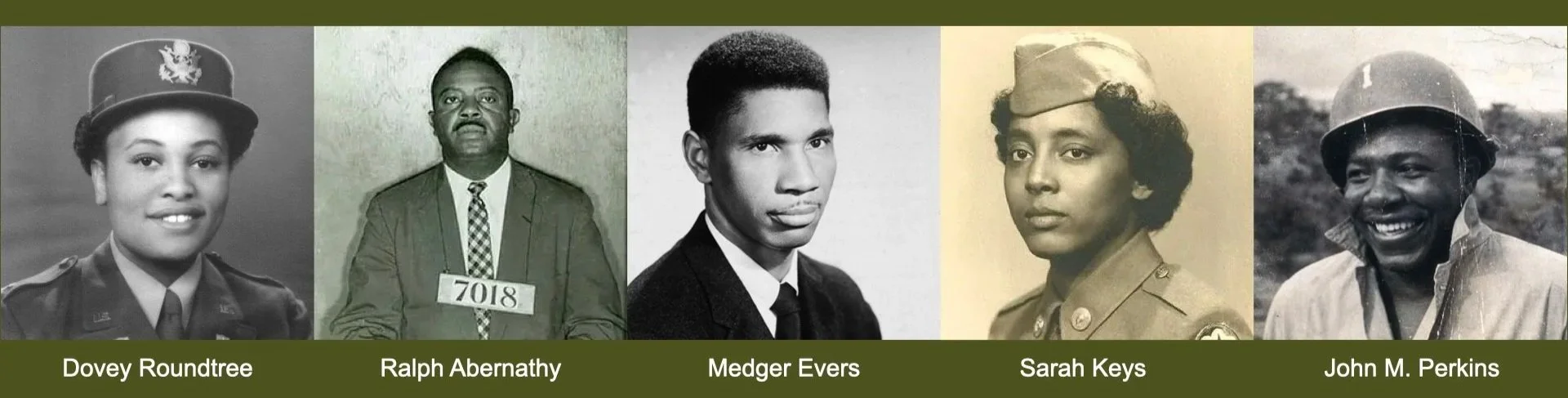
Keys, the daughter of a Black Navy WWI veteran, boarded a Carolina Coach at Fort Dix, New Jersey, on July 31, 1952 (Ignatius of Loyola's feast day, for what it's worth) heading home on leave. Two hours from her destination, in Roanoke Rapids, a new driver demanded she surrender her seat to a White Marine. She refused and was arrested. At her father's encouragement, she took the bus company to court, represented by Dovey Roundtree Johnson, the same officer whose bus-terminal humiliation nine years earlier had put her on the road to becoming one of the first women fully ordained in the AME Church and, not coincidentally, a lawyer. The case went to the Interstate Commerce Commission, which ruled in Keys's favor on November 1, 1955 — closing Morgan's loophole by extending the ruling explicitly to intrastate segments of interstate routes.
Here's the part that doesn't get taught: the ICC's ruling in Keys leaned directly on the reasoning of Brown v. Board of Education, decided a year and a half earlier. Brown had struck down "separate but equal" in public education without ever directly overturning Plessy v. Ferguson, the 1896 decision that established the doctrine in the first place — the justices sidestepped Plessy rather than confronting it head-on. The ICC, ruling on Keys, used Brown's logic to reject Plessy explicitly, in writing. It's the closest any judicial body has ever come to formally burying "separate but equal," and it happened because a Black soldier's father encouraged his daughter to fight a bus company, not because of a fresh challenge to school segregation.
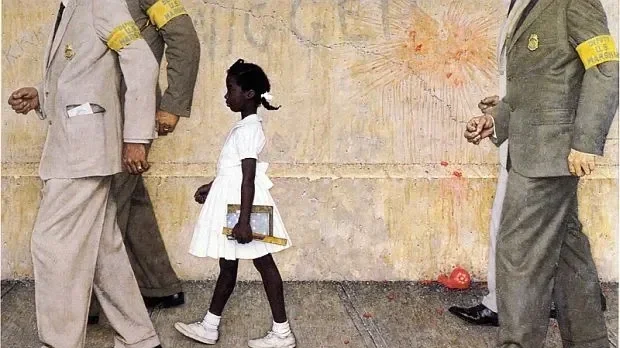
Norman Rockwell called racism “The Problem We All Live With”
Rosa Parks made her stand less than a month after the Keys ruling came down. She wasn't opening a new front. She was walking through a door that Irene Morgan and Sarah Keys — a defense worker and a soldier — had spent a decade prying open, one interstate commerce loophole at a time. The law was set. It just needed someone willing to get arrested to make the states enforce it.