GruntGod 2.8.4: Military DNA of Monasticism
Don’t Throw the BRAT out With the Bathwater
This is drawn from the revision of the Pachomius chapter in the second edition of God Is a Grunt.
The relationship between military culture and Christian monasticism is not metaphorical. It’s structural. And the scholarship to prove it has been sitting in plain sight, largely underread outside specialist circles.
The only intact Roman military training manual from late antiquity is Vegetius’s De Re Militari, written about a generation after Pachomius’s brief stint in service. Vegetius describes recruits training twice daily with mock weapons — wooden swords heavier than the real thing, the ancient equivalent of rubber duckies. He calls this training exerceo. The Greek equivalent is askesis.
This isn’t just an etymological curiosity. It means that when the early church developed its language for spiritual discipline — asceticism, the training of the soul — it was borrowing from the Roman military’s language for physical and tactical preparation. The monk’s cell was the barracks. The novitiate was basic training. The regulae were the UCMJ.
Pachomius, who was processed through a Roman recruit depot at Thebes and shipped to Antinopolis for training, experienced this directly. He never completed his service obligation — an entry-level separation — but the military had already gotten into him. When he established his cenobitic (communal) monastic communities along the Nile, he organized them in ways that historian Christian Barthel has documented carefully.
Entry into the Pachomian community involved what Barthel calls ‘Trials of Commitment’ — an initiation process that functioned, by any honest description, as hazing with theological framing. If successful, novices took public vows before witnesses. Monastic rank was determined not by age or social status but by date of profession — the date you swore in. A twenty-year-old professed five years ago outranks a fifty-year-old professed last year. Any veteran will recognize that logic immediately.
Community correction was public and involved the symbolic stripping of the cingulum — the belt that, in Roman military culture, signified rank, citizenship rights, and veterans’ benefits. A dishonorable discharge meant losing your cingulum. In Pachomius’s community, a monk facing correction could signal penitence by loosening his belt before the whole assembly, avoiding expulsion. The ritual consequence of violation — public, symbolic, carrying both individual shame and communal implications — maps almost exactly onto Roman military punishment.
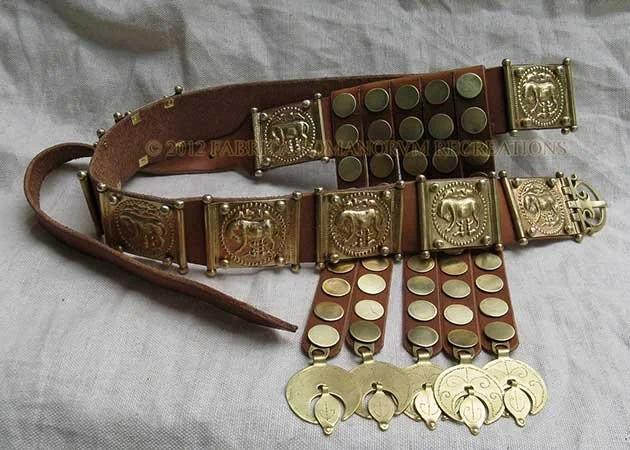
cingulum militare, click for source
What Barthel’s research establishes is not that Pachomius consciously copied military culture into monasticism. It’s that the two institutions were drawing from the same anthropological well: the logic of formation through community, shared identity through common rule, rank earned through time and commitment, and corrective processes that balance accountability with restoration.
Antony had intuited some of this — he chose an abandoned Roman military fort as his hermitage, equipped himself with the armor of God, and after decades of spiritual combat would have been considered a veteran fit to train incoming recruits. But Antony’s framework remained individualized. Pachomius operationalized it. He built not a hermitage but a post.
The theological significance runs deeper than organizational structure. The martyrs had been the church’s highest expression of fidelity — they showed the world what the gospel was worth by paying for it with their bodies. When the age of martyrdom ended, the church needed witnesses. Pachomius gave them communities where the logic of the martyrs — shared suffering, public commitment, the subordination of individual preference to communal life — could continue to operate without requiring persecution. That’s the thesis of Chapter 2.8. The academic scaffolding behind it is here.