GruntGod 2.9.4: What Happens to the Bones ☠️
Relics, Politics, and the Constantinian Shift
This is drawn from the revision of the Martin chapter in the second edition of God Is a Grunt.
Martin of Tours died on November 8, 397, at a small church he had founded a few miles downriver from Tours, in a village called Candes. His disciples intended to bury him simply, in an unmarked grave, consistent with the austere life he had lived. The residents of Tours had other ideas. Under cover of night, they stole his body, transported it back to the cathedral, and buried him there with full honors. The feast of his burial is November 11th.
Veterans Day, for those keeping score.

The theft of Martin's body tells you something about what saints' remains had come to mean by the late fourth century. Relics — the bones of holy people, or objects that had come into contact with them — were believed to carry spiritual power. Communities competed for them. They anchored the local church's authority, attracted pilgrims, and generated economic value. Martin's body was an asset. 🤑
This represents a significant mutation from where relics began. The earliest Christian communities honored their dead at the graveside — simple commemoration, community formation, keeping faith alive under persecution. Nobody was stealing bodies because the saints' remains weren't thought of as portable power sources or revenue streams. They were anchors for community memory.
The Constantinian shift changed this. Once Christianity became politically useful to the imperial project, the cult of the saints got co-opted. The emperor's mother Helena is the canonical example: she claimed to have found pieces of the True Cross during a pilgrimage to Jerusalem, as well as the spear used by the soldier Loginus to pierce Jesus' side at the crucifixion. Whether or not these were authentic (they were almost certainly not), the political utility of possessing them was enormous. Relics became instruments of legitimation; whoever held the bones of the martyrs held a kind of spiritual authority that no council or edict could manufacture.
Martin's half-cape, the cappa Sancti Martini, the half he kept after cutting it for the freezing beggar at Amiens, became one of the most significant relics in medieval Europe. A royal inventory from a church in northern France in the seventh century already records it as a treasured possession. Kings carried it before them on the field of battle, swearing oaths on the garment of a man who had refused to fight. The irony is thick enough to choke on.
This is the bitter paradox Martin embodied and that his relic-veneration then immediately violated. His cape represented the act of care (clothing the naked, recognizing Christ in the suffering stranger) that defined his spiritual life. The empire turned it into a battle standard, an idol.
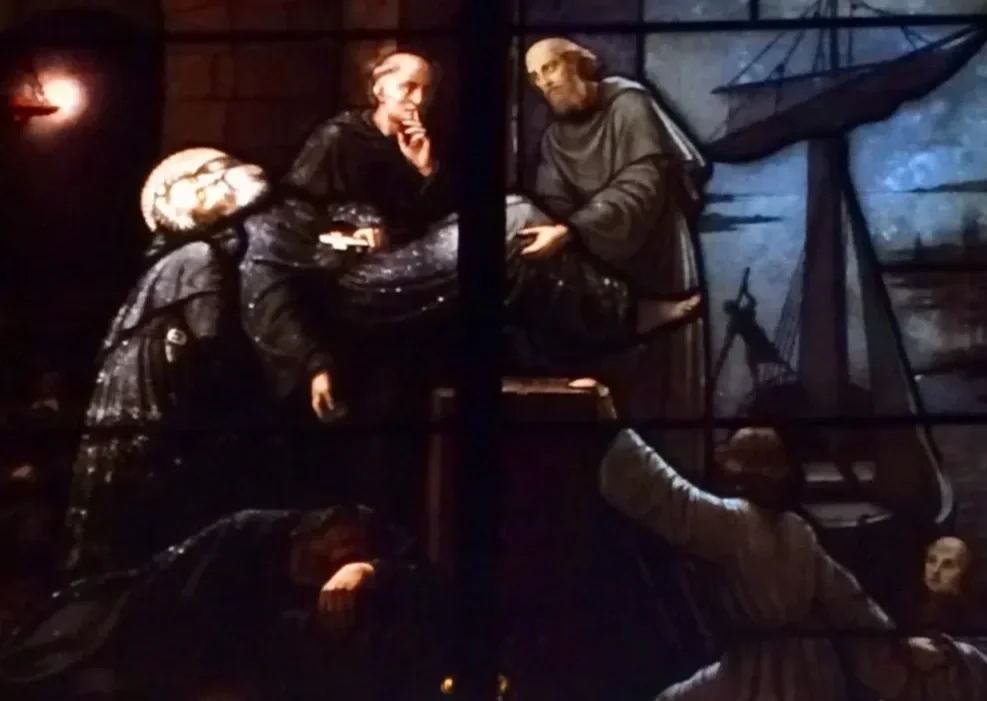
Urban elites from Tours steal Martin’s corpse as the pastor of the church in Candes sleeps. Detail of a stained glass window in the St Martin chapel.
By the time French revolutionaries tore apart the cathedral of Tours in the eighteenth century, using the lead from the roof as ammunition, the institutional church had been trading on Martin's legacy for fourteen hundred years while doing a decent impression of everything he opposed. The revolutionaries' contempt for the cathedral was at least partly a contempt for that institution's corruption, which is not to say they were right to tear it down, but to say that the corruption they were reacting against was real.
The lesson for military families is uncomfortable: the church has a long history of co-opting the stories of soldiers for institutional purposes while systematically failing to actually serve them. Martin's story got used to legitimize wars he would have refused to fight. His feast day became a holiday that the church then mostly forgot to connect to the veterans honored on the same date.