GruntGod 2.10.2: How ‘Taking up the Cross’ got Weaponized
This is drawn from the revision of the Francis chapter in the second edition of God Is a Grunt.
Before 1095, the symbol of Christian pilgrimage was a scallop shell, not a cross. There were practical reasons (the shell scoops water, functionally a pilgrim's canteen) and devotional ones: the shell's ridges converge at a single point on the hinge, the same way every pilgrim path was said to converge on God. It's a peaceful symbol. Nobody killed anybody over a scallop shell.
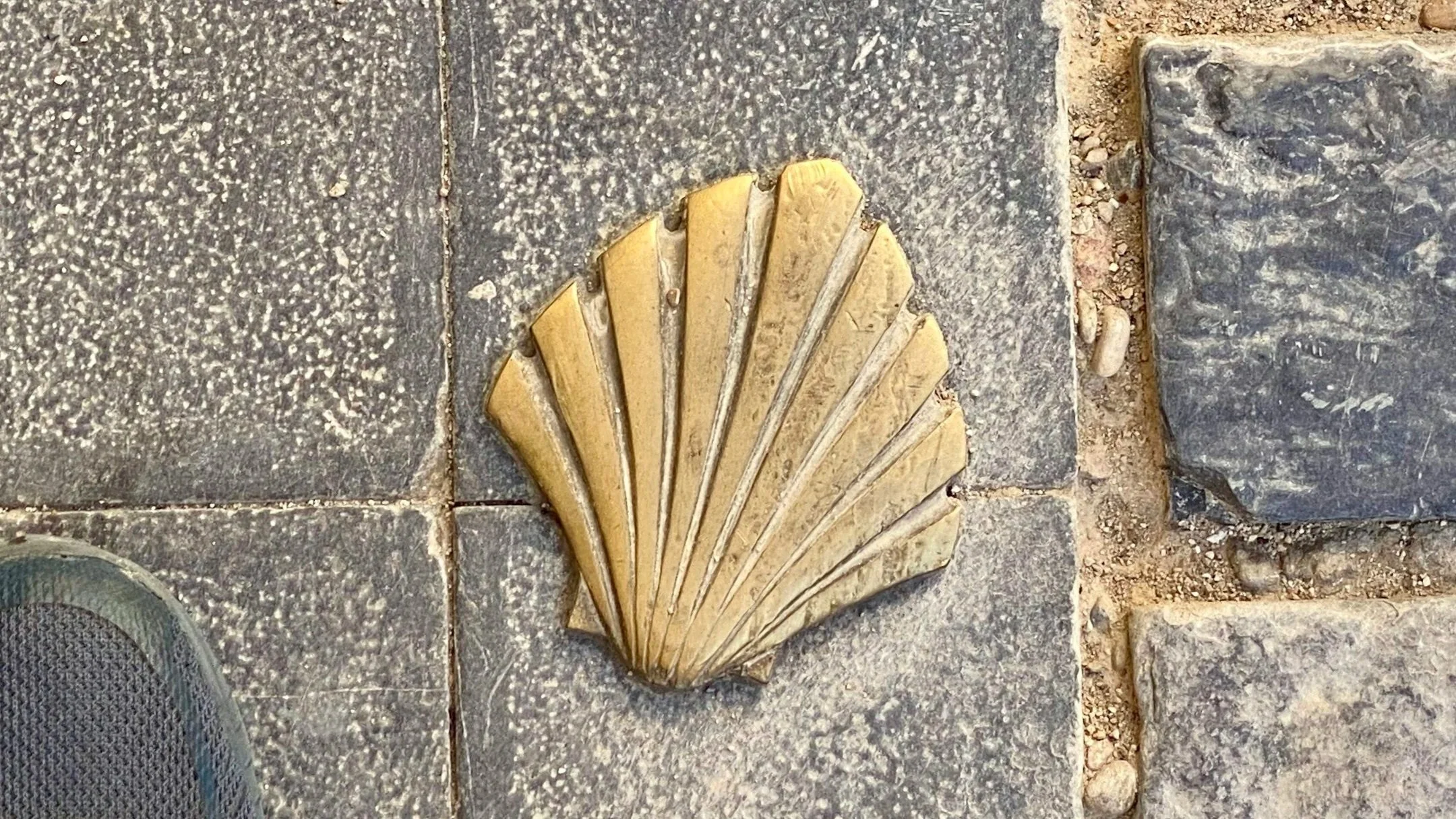
Pilgrim medallions like this are common markers for religious sites around Europe.
That changed when Pope Urban II called for the First Crusade at Clermont in November 1095. What he actually preached, according to the sources, was a pilgrimage — but with a theological rider attached that no earlier pilgrimage tradition had carried: those who die "by the way, whether by land or by sea, or in battle against the pagans, shall have immediate remission of sins." That single sentence is the hinge the entire crusading project turns on. Dying in transit to Jerusalem, or dying in combat en route, now carried the same spiritual payoff as arriving.
The earliest published eyewitness account, the Gesta Francorum et aliorum Hierosolimitanorum ("The Deeds of the Franks and the Other Pilgrims to Jerusalem"), records the reaction: hearers "caused crosses to be sewed on their right shoulders, saying that they followed with one accord the footsteps of Christ." Note the word choice. Not soldiers. Pilgrims. The Gesta's author opens with a Latin quotation lifted straight from Jerome's Matthew 16:24 — "let them deny themselves and take up their cross and follow me" — cherry-picked to retroactively justify what was, functionally, an armed invasion.
This is where cruciata enters the vocabulary: Latin for "marked with the sign of the cross." It's the root of the French croisade, which didn't get anglicized into "crusade" until the early 1700s — centuries after the events themselves. The people doing the fighting never called it a crusade. They called themselves pilgrims wearing the cross, and that's precisely the branding problem. The word for the ritual (taking up the cross) and the word Joshua+ used for discipleship (taking up your cross) were now identical, and kings, not theologians, controlled which meaning won.
Constantine's mother, Helena, had already primed the pump for this centuries earlier. After Constantine legalized Christianity, she went hunting for relics in the Holy Land and claimed to have found the True Cross itself. By 333 CE, documentary evidence shows a functioning pilgrim economy in Jerusalem — travel itineraries, guides, souvenirs. Pilgrimage was already commercialized and physicalized long before it got militarized. Urban didn't invent devotion to the cross; he redirected an existing, popular, physical practice toward an army's objectives.

I bring all this up because it's the exact move Francis had to undo a century later — not by arguing theology with the pope, but by building an alternative ritual (the nativity scene, eventually the Stations of the Cross) that let "take up your cross and follow me" mean something closer to what Joshua+ meant by it. You can't out-argue a symbol. You can only build a better one and wait for it to outlast the bad one. Francis did. It took about four hundred years, but the stations are in more churches today than the Crusades ever conquered territory.