We Gotta Talk About Protest Suicides
I had three civilian friends ask me how I felt about Aaron Bushnell’s protest/suicide before it even registered that I should maybe say something. That’s not because I don’t care, far from it. I didn’t chime in on Aaron Bushnell’s because protest suicides are a dime a dozen for veterans (and have been). It must be said upfront that people take their own lives for many reasons, even if protest suicides are unique in their political function; the soon-to-be deceased is deliberately and overtly confronting our desire to look away, our expectation that nothing is worth dying for. That is where Christianity (and military service) helps us make sense of something so seemingly senseless.
Here are three takeaways from this tragic, hopefully soon-to-be-rare occurrence;
Protest suicides are nothing new
Over a 14 month span from 2017 to 2018, nineteen veterans took their own lives 👏 on 👏 federal 👏 property “to highlight how little help they were given in their time of need by the VA system.” Even though less than half of cases occurred there, a Washington Post report several months later was titled “The Parking Lot Suicides.” Only the best stuff happens in parking lots, amIright?
*For us Poors who can’t afford to pay for news in the new attention economy, the Military Times has a summary, from which I quoted.
Aaron Bushnell’s particular method, self-immolation, is not new either. Boomers are likely familiar with Thích Quảng Đức, who, in 1963, set himself ablaze on the streets of Saigon to highlight the persecution of fellow Buddhists in South Vietnam. Self-immolation is not considered acceptable within Christianity, and its rare occurrences have either been motivated by end-times fantasy (as with Russian “Old Believers”) or limited to a limb or two (as with French Jesuits).
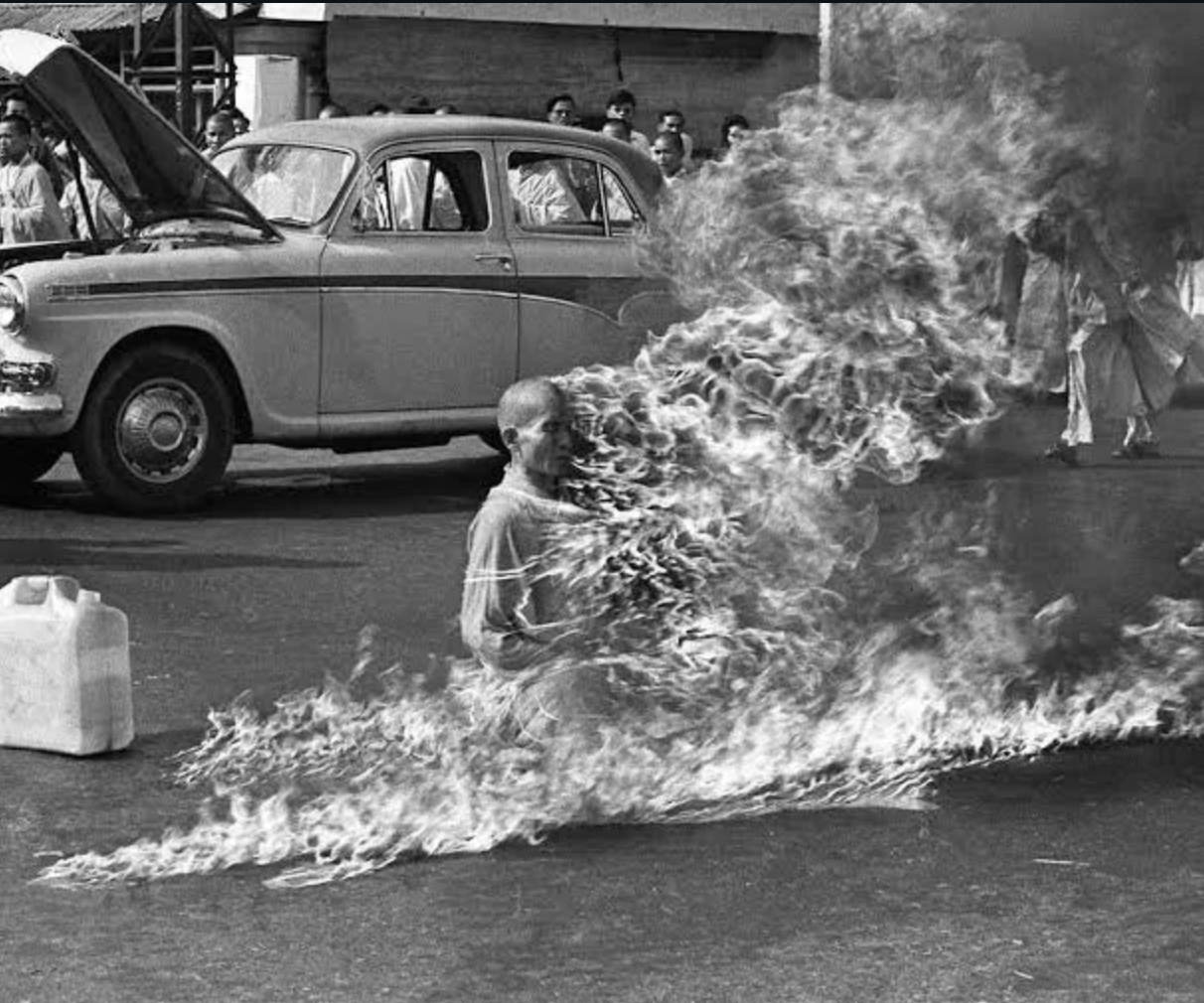
Malcolm Browne’s 1963 image adorned the front page of major newspapers. Twitch had Aaron' Bushnell’s video removed within 24 hours.
Meaning is more important than survival
I never knew Aaron Bushnell, and I have no idea why he ultimately chose the path he did. But if there is anything safe to assume from Aaron Bushnell’s decision, it’s that he saw his own life as less valuable than his chosen message; “Free Palestine.” Now, I’ve been to Palestine. To be Palestinian was a hellish existence back in 2006, before the Hamas-inspired shitscape it has become. But dying…? By fire?! Why TF couldn’t he have posted it to Facebook like a regular person, or shouted it at the top of his lungs at a rally? As soldiers, Aaron Bushnell and I learned that survival is not the point. Sometimes there is something worth more than our live, something from which we can derive meaning.
When I visited the West Bank on terminal leave in October 2006, the story of The Angel of Rafah, Rachel Corrie, was fresh. If you ask the people I travelled with, they may tell you a different story, but I don’t know if I’d die for Palestine, certainly not as a spouse and father. Rachel did, and, by some accounts, she did so voluntarily. The message her life left is indistinguishable from Aaron’s, even if the method and culpability are different. Do we really want to say that freedom, even for others, is not worth human life or two?
Mental Health is an insufficient paradigm
The decision to take one’s own life may be hard to understand, but that doesn’t justify a pseudo-diagnosis of “mental distress,” which is how the DC police chose to characterize Aaron’s state of mind (posthumously, mind you). Chalking it up to mental illness of any kind invalidates his agency, and diagnoses outside treatment happens to violate professional codes of conduct. More importantly, not everyone who takes their own life suffers from mental illness (think: crimes of passion), and not everyone with mental illness is necessarily a suicide risk. Even if it were appropriate to diagnose a complete stranger, Christians should know that mental health is an insufficient paradigm. After all, we have the martyrs to explain.
To be clear, there are important differences between suicide and martyrdom, not the least of which being the agent responsible for the act. But where does the line fall? Does Saint Stephen share some fault for his death because he didn’t just STFU? Polycarp of Smyrna, a bishop one generation after the Apostles, even invited the violence, essentially saying “What’re you waiting for? Kill me.” (See Ch. 11) Polycarp didn’t strike the match (yes, the first post-Biblical martyr expressed a desire to “be burnt alive”), but without a more nuanced morality we can’t say he was entirely innocent either.
If Aaron Bushnell is crazy for valuing his life insufficiently, than I must be crazy too. And so is every soldier and veteran who has ever served in the name of democracy. And so is Christ, while we’re at it, for snubbing death. If Christianity is indeed crazy, then it is in the eyes of an insane society. Like the nation repulsed by one soldier’s Protest Suicide because he managed to livestream it, but silent in the face of countless others just because they weren’t televized. The attention economy has made it harder to look away, at least until it can be flagged and scrubbed by the tech-bros in charge.
Here’s my advice for making sense of this seemingly senseless tragedy;
Instead of asking soldiers and veterans how they are, ask what’s important to them and amplify their message by sharing, retweeting, etc. Aaron desperately wanted as many people as possible to feel something about Palestine. If you’re worried about a veteran you know, ask them what you can do to support them. And then do it.
Consider who the media amplifies in this moment, and ask yourself why. Are the main voices 1) progressive or conservative, 2) military or civilian, 3) enlisted or commissioned? Aaron was a progressive enlisted Airman. Spokespeople whose experiences reflect his own should be privileged over those unlike him.
Finally, if you want to honor Aaron’s memory, educate yourself by joining a discussion group about Israel/Palestine. If you can’t articulate the difference between Mandate Palestine and the Oslo Accords, then STFU before you choose a side.