Joshua

יְהוֹשׁוּעַ • Yehoshua
Semantic Field: Salvation, Vocation & Typological Identity
Etymology & Definition
Yehoshua (יְהוֹשׁוּעַ) is a compound proper name: the theonym Yah (יָהּ, the shortened form of YHWH) prefixed to the root yāšaʿ (יָשַׁע, H3467), meaning to deliver, save, or bring to wide open space. It is most literally rendered YHWH is Salvation or God saves.
The name originates as a divine commission. In Numbers 13:16, Moses renames his aide Hoshea son of Nun — Hoshea (H1954) meaning simply salvation, with no divine reference — by adding the theonym. The renaming is not cosmetic. It encodes a mission statement and a sponsor. What Hoshea would do, YHWH was doing through him.
The shortened form, Yeshua (יֵשׁוּעַ, H3442), drops the divine prefix syllable — like Robert to Rob, Elizabeth to Beth — and was the common spoken form in the Second Temple period. Yeshua is the passive participle of yāšaʿ, meaning not just salvation as an abstract noun but the one being saved or the one through whom saving is done. It is how Yehoshua becomes Ἰησοῦς (G2424) in Greek, and Iesus in Jerome's 4th-century Latin — and eventually Jesus in English. The name was not lost in translation. It was transliterated, then transliterated again, until the etymology became invisible to most readers.
That invisibility is the problem this entry addresses. English readers who encounter "Jesus" in the New Testament have no way of knowing they are reading the same name as the military commander in Joshua, or the high priest in Ezra. The Greek-speaking communities who first received the Gospels did know. The resonances were built into the name's very sound.
Three Bearers, One Name
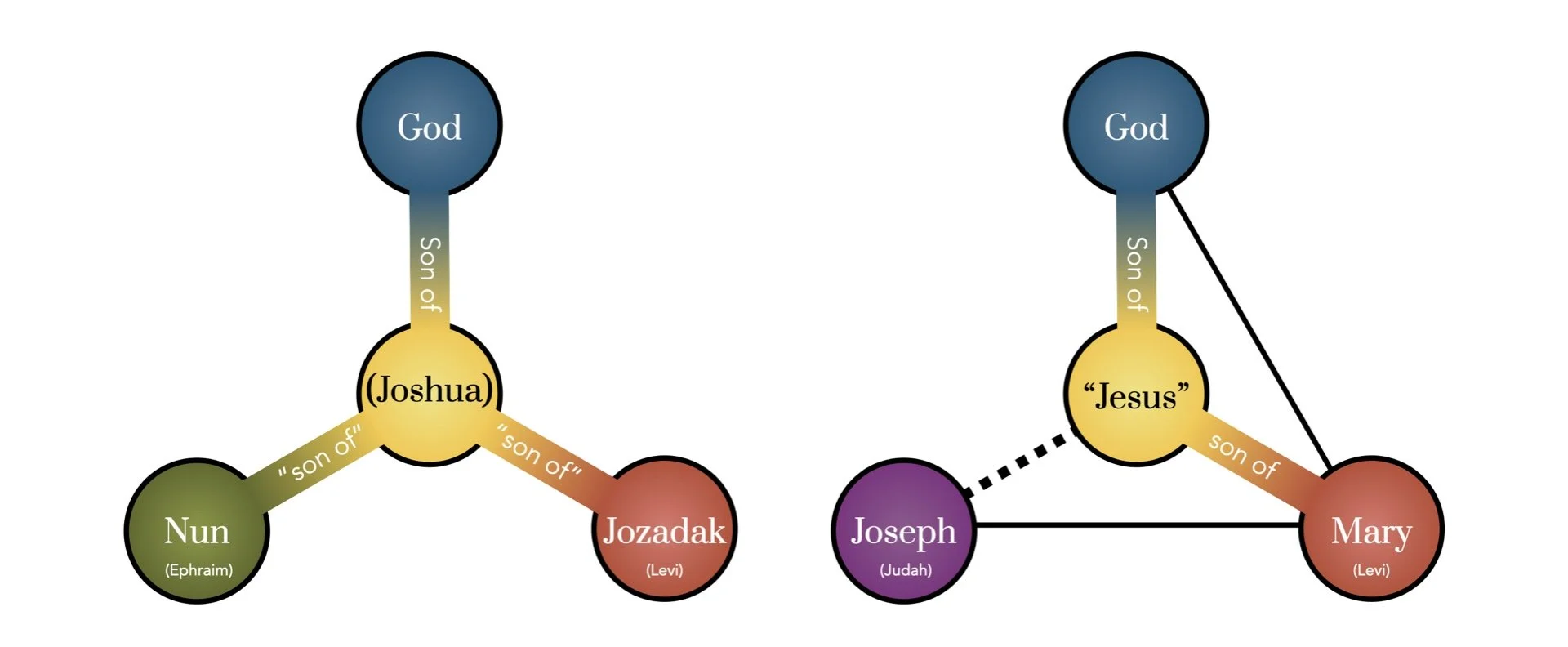
There are many Joshuas in the Hebrew scriptures — the name was not uncommon. But only three carry it as an explicit patronym, ben (son of), with the father's name given, and only these three are assigned a world-historical role that the name itself announces. The diagram below illustrates the parallel structure: each Yehoshua is son of a human father and son of God in some operative sense — the third being the one where the dotted line replaces the solid one.
Yehoshua ben Nun — The Military Commander
Tribe of Ephraim. Successor to Moses. Conqueror of Canaan.
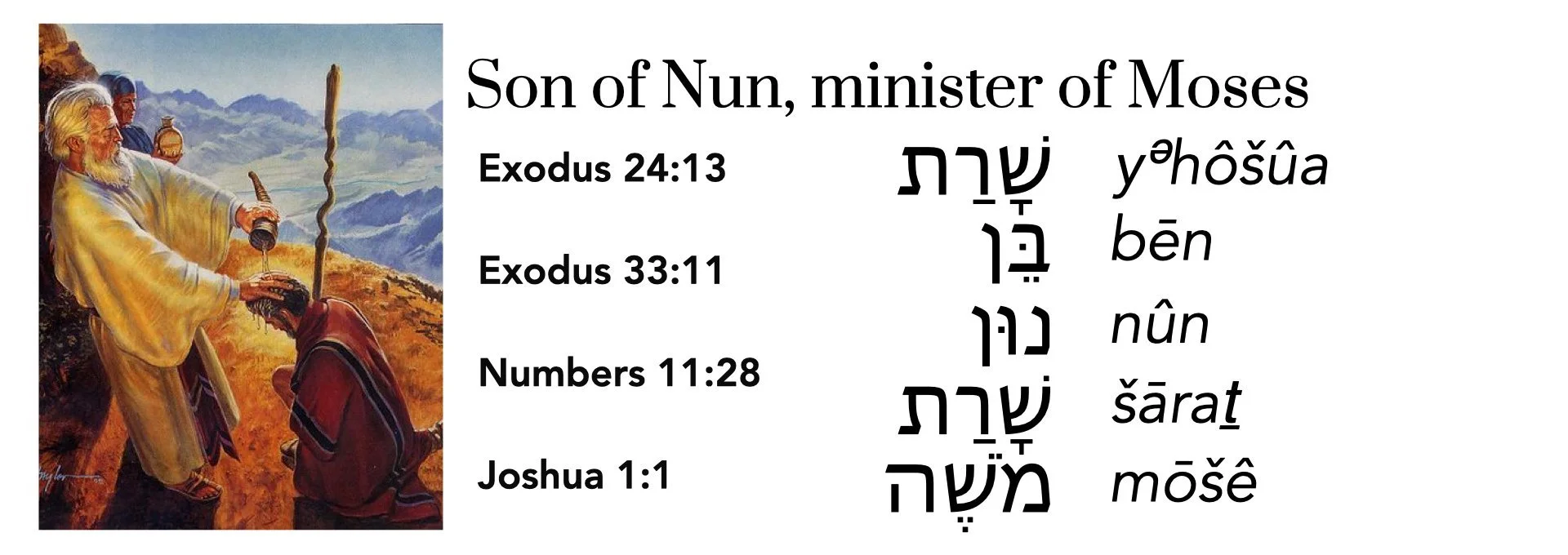
The Son of Nun is introduced as Moses' mesharet (H8334) — his minister, aide, attendant. He appears early, in Exodus 17, commanding Israel's first battle against Amalek while Moses holds his arms aloft on the hill above. He is present at the tent of meeting, on the mountain, at the spying of Canaan. He is Moses' shadow before he becomes Israel's arm.
After Moses dies at the edge of the promise, Yehoshua ben Nun crosses the Jordan — the same water that Israel passed through at the exodus, now going the other direction — and leads seven years of campaigns to clear and distribute the land. The book that bears his name is among the most contested in the canon: a record of conquest that modern readers find troubling and ancient readers found sanctifying. The LORD's repeated instruction to Joshua is not fight well but be strong and courageous, for I am with you (Josh. 1:9). The military action is secondary to the presence.
His two patronyms — son of Nun and son of Ephraim — place him in the northern tribes, outside the royal and priestly lines. He holds no hereditary office. His authority is given, not inherited.
Key texts: Numbers 13:16; Joshua 1, 10, 24; Exodus 17:8–13
Yehoshua ben Yehozadak — The High Priest
Tribe of Levi. First High Priest of the Second Temple. Founder of the post-exilic religious order.
The Son of Jehozadak appears in the books of Ezra, Nehemiah, Haggai, and Zechariah — the literature of return. When the Babylonian exile ends and the Persian king Cyrus permits the Jewish people to go home, it is Yehoshua ben Yehozadak who oversees the altar's restoration and the Temple's rebuilding. He is named alongside Zerubbabel (the Davidic governor) as the two pillars of the restoration: the priestly and the royal working in tandem.
In Ezra he is called Jeshua son of Jozadak — the shortened form, Yeshua, because this is already the Second Temple period when the name's pronunciation had shifted. He is the same person: the editorial variation in the text is phonological, not biographical.
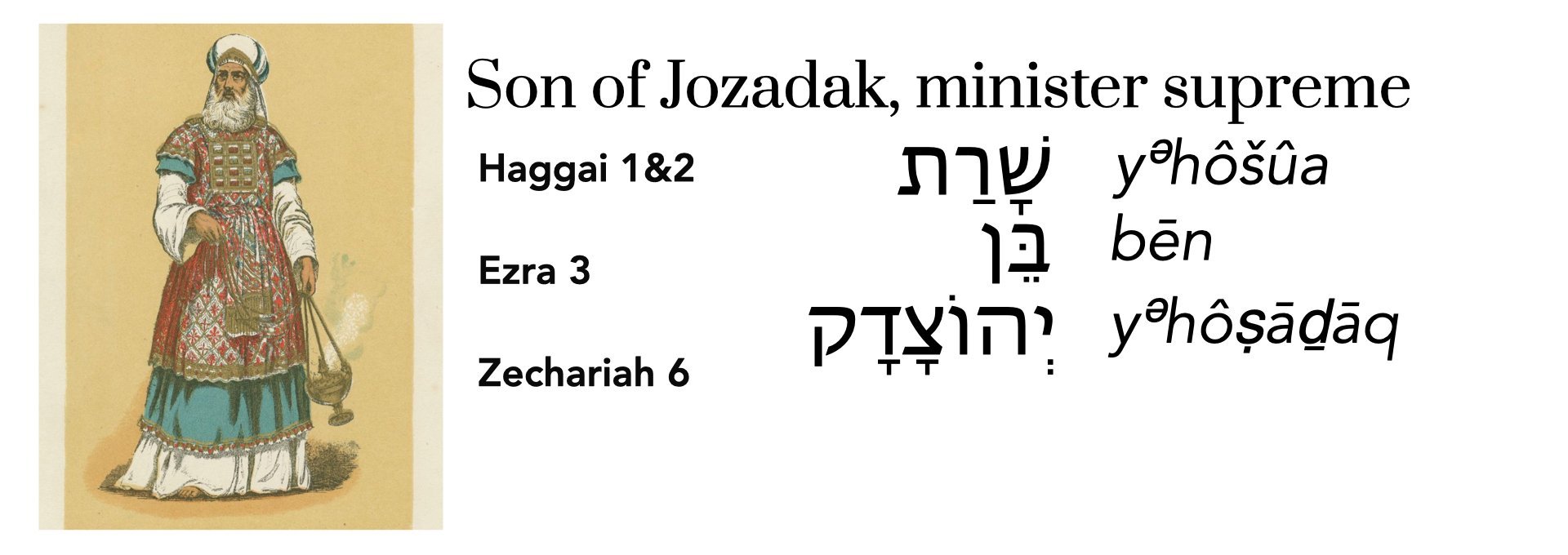
The passage that makes him singular is Zechariah 6:11: the prophet is commanded to take silver and gold, make a crown, and place it on the head of Yehoshua ben Yehozadak. A priest, crowned. In the typological imagination of the Hebrew scriptures, this is a loaded gesture — the crown belongs to the king, the turban to the priest. Zechariah either collapses the distinction deliberately or is pointing toward someone who will fill both offices at once.
His Levitical lineage (son of Jozadak, son of Seraiah — 1 Chr. 6:14–15) establishes priestly legitimacy. His father Jozadak was carried into exile by Nebuchadnezzar; Yehoshua ben Yehozadak is the first of his line born in Babylon, the first to serve in Jerusalem. He is a priest of the diaspora, a minister of return.
Key texts: Ezra 2:2; 3:2–9; Nehemiah 12:26; Haggai 1:1; Zechariah 3:1–10; 6:11
Yehoshua ben Miriam — The Messiah
Tribe of Levi by birth, Judah by adoption. Son of Mary. Born under Roman occupation.
The patronym problem is the tell. Every significant person in Second Temple Jewish culture was identified by their father's name. The absence of a settled patronym for Jesus in the Gospel tradition is not an oversight — it is the argument.
Luke hedges: "being the son (as was supposed) of Joseph" (3:23). Mark, the earliest Gospel, has people from his hometown call him "son of Mary" (6:3) — a formulation that in the ancient Near East implied the father was unknown, absent, or unsuitable to name. Matthew gives Joseph a legal role through the genealogy but is explicit that Joseph "knew her not" before the birth (1:25). The Fourth Gospel avoids the patronym problem by making the divine Sonship the entire frame.
The name given by the angel to Mary is Yehoshua, and the reason given is explicit: "he will save his people from their sins" (Matt. 1:21). The name is not a given; it is a mission brief. This Yehoshua will do what the name has always announced — deliver, save, bring into open country — but will do so in his own person, without a land grant, without a temple building project, without an army. He is the Judge who needs no election, the Priest who requires no appointment, the King who arrives on a borrowed donkey.
The diagram's dotted line between "Jesus" and Joseph is not a theological evasion. It is a structural marker: this patronym is interrupted. The solid line to Mary and the solid line to God indicate where his identity actually comes from. He is ben Miriam when the people need a human anchor; he is ben Elohim when Matthew, Luke, and John need to explain what they saw.
Key texts: Matthew 1:21–25; Luke 1:31; 3:23; Mark 6:3; John 8:42
Theological Insight
The three-in-one structure of the name Yehoshua is not a later Christian overlay. It is present in the Hebrew scriptures before the Gospels were written. The first Yehoshua is a military commander who crosses water, distributes land, and is told YHWH fights for him. The second is a priest who rebuilds the Temple, is crowned at the prophet's command, and restores the sacrificial order from exile. The third arrives when the Temple of the second Joshua is being torn down by Herod and replaced — and builds one that cannot be demolished.
What the name carries that "Jesus" cannot: when a first-century Jew heard Yehoshua ben [Name], they were already doing typological work. The name activated a field of reference that included conquest, priesthood, and the Judge-Deliverer tradition of Judges 2:16. The Son of Mary enters a name already loaded with military and ministerial weight. He does not replace those meanings. He completes them — telos, in the LXX sense.
This is why the angel's instruction to Mary is theological, not merely sentimental: call his name Yehoshua, because he will save his people. The name is the vocation. The vocation was already embedded in Israel's history twice before.
REFLECTION POINT
English Christianity inherited the name "Jesus" without the resonance. Every time a Hebrew-literate first-century listener heard Yehoshua, they heard YHWH saves — and probably thought of a general and a high priest before they thought of anything else. What would it change about your reading of the Gospels to hear the name that way? When the crowd in Jerusalem called out Hosanna ("save us now"), they were calling on the same root — and possibly invoking both predecessors at once.
Cross-References
H3442 (יֵשׁוּעַ, Yeshua) — the shortened Second Temple form; same name, same bearer in Ezra/Nehemiah. The "ho" is dropped, like Elijah to Eli. Yeshua is also the passive participle of yāšaʿ: the one who saves / through whom saving happens.
H1954 (הוֹשֵׁעַ, Hoshea) — the name before the renaming. Salvation without the theonym. What Joshua was called before Moses commissioned him in Numbers 13:16.
H3467 (יָשַׁע, yāšaʿ) — the root verb: to save, deliver, bring to wide open space. The verb from which both Hoshea and Yehoshua are formed. Its passive participle is Yeshua.
G2424 (Ἰησοῦς, Iēsous) — the Greek transliteration of Yeshua, via the Septuagint's rendering of the book of Joshua. The sound yay-soos is Yeshua in Greek dress. Jerome rendered it Iesus in Latin; English swapped I for J. The name was not replaced — it was carried forward phonologically while the etymology was left behind.
H4421 (מִלְחָמָה, milḥāmâ) — war, battle; see H3898 (lāḥam). The military Joshua's primary arena. The third Joshua reframes its terms.
H6944 (קֹדֶשׁ, qōḏeš) — holiness, the set-apart; the priestly Joshua's domain. What the Temple was meant to protect and the third Joshua was said to embody.
Double-click to edit...