H3898 (fight)

לָחַם • lāḥam
Semantic Field: Warfare & Combat
Etymology & Definition
The three-consonant Hebrew root L-Ḥ-M carries a semantic range that English translations flatten into "fight" or "make war." But the root's breadth tells a different story: lāḥam can mean both combat and consumption. The noun form milḥāmâ (H4421) literally means "that which devours." When Deuteronomy 32:24 says people will be "devoured (lāḥam) by plague," it's using the same root we translate as "fight" in military contexts.
The related adjective ḥāmaš (H2571), "armed," sits uncomfortably close to ḥōmeš (H2570), "obese"—both describing bodies prepared to consume or be consumed. This isn't coincidental wordplay. Combat in the ancient Near East was understood as mutual devouring, the consuming of bodies and cities and peoples.
Here's what matters most: Hebrew has no word for "fighter" as an identity. The participial form lokhém (לוחם) never appears in the Hebrew Scriptures. You can lāḥam (verb: to fight), you can participate in milḥāmâ (noun: war/battle), but you cannot be a lokhém (noun: fighter/warrior). Strong's Concordance has no entry for this word because Scripture refuses to create it.
Key Occurrences
The first mention of lāḥam comes from Egyptian lips: "If war (milḥāmâ) breaks out, they might join our enemies and lāḥam against us" (Exodus 1:10). Israel's enemies introduce the concept of fighting, not Israel itself.
When Israel does fight, the verbs are carefully attributed:
Exodus 14:14 – "YHWH will lāḥam for you, and you have only to be silent."
Deuteronomy 1:41-42 – Israel declares "We ourselves will go up and lāḥam," but YHWH responds: "Do not go up or lāḥam, for I am not in your midst."
Joshua 10:14, 42 – Twice the narrator insists "YHWH lāḥam for Israel" to frame the conquest accounts, even though verses in between describe Israel's military actions.
Joshua 23:3, 10 – Past and future tense: "YHWH your God has lāḥam for you... one man of you puts to flight a thousand, since it is YHWH your God who lāḥam for you."
The pattern is unmistakable: when humans lāḥam, the text works overtime to clarify agency. Fighting happens, but the fighting is YHWH's prerogative.
Theological Insight
Hebrew's refusal to provide a noun for "fighter" or "warrior" (lokhém) isn't an accident of vocabulary. It's a theological claim embedded in grammar itself.
Every other ancient Near Eastern culture had words for professional warriors. Hebrew had words for soldiers (ḥayil, H2428), men of war (ʾanšê milḥāmâ), even mighty men (gibbôr, H1368). But it never created a stable identity category of "one who fights." You could be doing fighting, but you couldn't be a fighter. That status belonged solely to YHWH, who is repeatedly called "a man of war" (ʾîš milḥāmâ, Exodus 15:3).
This creates massive problems for how civilian Christianity talks about military service. We've imported warrior-identity language wholesale—"warrior for Christ," "prayer warrior," "spiritual warrior"—using a category that Hebrew systematically refused to create. We've made an identity out of something Scripture treated as an activity that required constant divine authorization and attribution.
Does this mean pacifism is the only faithful reading? No. The Israelites clearly engaged in battle. But it does mean that Hebrew theology won't let fighting become the kind of stable identity we're comfortable with. The tradition tolerates its members fighting but refuses to tolerate them being fighters in any permanent sense. The moment you make "warrior" an identity independent of YHWH's specific command in specific circumstances, you've departed from the grammar of the text.
That's not a comfortable middle position. That's the text refusing to let anyone off the hook—neither the pacifist who wants to condemn all military service, nor the warrior who wants to claim fighting as a stable identity apart from divine command. Hebrew keeps the tension alive in the grammar itself.
Reflection Point
When we call someone a "warrior," we're using a category Hebrew refuses to provide. That refusal isn't accidental—it's theological resistance to making violence a stable identity. What does it mean that American Christianity freely creates the identity category (lokhém) that Hebrew won't name, while simultaneously avoiding the verb (lāḥam) that Hebrew requires YHWH to authorize each time? Are we more comfortable with warriors than with the God who fights?
Extended Examples
Torah Usage (18 total occurrences)
Exodus 14:25 – "The Egyptians said, 'Let us flee from before Israel, for YHWH lāḥam for them against us.'" Even Israel's enemies recognize the agency.
Exodus 17:8-10 – "Amalek came and lāḥam with Israel... Moses said to Joshua, 'Choose for us ĕnôš [H582, mortal men], and go out and lāḥam with Amalek.'" Note that Moses doesn't choose gibbôrîm (mighty warriors) but ĕnôš (frail mortals). Joshua does as commanded and lāḥam with Amalek.
Deuteronomy 1:30 – "YHWH your God... will himself lāḥam for you."
Deuteronomy 3:22 – "Do not fear them, for it is YHWH your God who lāḥam for you."
Deuteronomy 20:4 – "YHWH your God is he who goes with you to lāḥam for you against your enemies."
Deuteronomy 20:10 – "When you draw near to a city to lāḥam against it, offer terms of peace to it." Even when Israel initiates combat, peace terms come first.
Deuteronomy 20:19 – "When you besiege a city for a long time, lāḥam against it to capture it, you shall not destroy its trees by wielding an axe against them... Are the trees in the field human (ʾādām, H120), that they should be besieged by you?" War has limits; creation isn't the enemy.
Joshua's Complex Attribution
Joshua 10:14, 25, 42 – Three times in one chapter: "YHWH lāḥam for Israel." The repetition frames verses that appear to describe Israelite military action, insisting on divine agency even when human agency is evident.
Joshua 19:47 – "The people of Dan went up and lāḥam against Leshem, and after capturing it and striking it with the sword they took possession of it." No attribution to YHWH—and notably, this conquest wasn't commanded in the original allotment. When Israel fights outside divine mandate, the passive attribution disappears.
Joshua 23:3, 10 – "You have seen all that YHWH your God has done to all these nations for your sake, for it is YHWH your God who has lāḥam for you... one man of you puts to flight a thousand, since it is YHWH your God who lāḥam for you."
Joshua 24:8, 11 – "I brought you to the land of the Amorites who lived on the other side of the Jordan. They lāḥam with you, and I gave them into your hand... The leaders of Jericho lāḥam against you, and also the Amorites, the Perizzites, the Canaanites, the Hittites, the Girgashites, the Hivites, and the Jebusites. And I gave them into your hand." YHWH speaks in first person, claiming the victory while acknowledging that multiple peoples lāḥam against Israel.
Cross-References
Related TFW Entries:
- H4421 (milḥāmâ) – The noun form, "that which devours," typically translated "war" or "battle"
- H6635 (ṣāḇāʾ) – "Army" or "host," the assembled force that participates in milḥāmâ
- H1368 (gibbôr) – "Mighty man," the closest Hebrew gets to a warrior-type, but still not a professional fighter identity
- H2428 (ḥayil) – "Force" or "army," also translated "valor" or "wealth"
Septuagint Note:
The LXX translates lāḥam with polemeo (to make war) and lāḥam with machē (battle/fight). Greek had clear warrior-identity words (machētēs, polemistēs), but the LXX translators honored Hebrew's grammatical refusal by using verbs and abstract nouns rather than agent nouns. They could have Hellenized the theology; they chose to preserve the tension.
Metadata
Tags: fight, war, combat, agency, divine-warfare
Blue Letter Bible: H3898
Related Reading: God is a Grunt, Chapter 3: "The Fighting Faith"
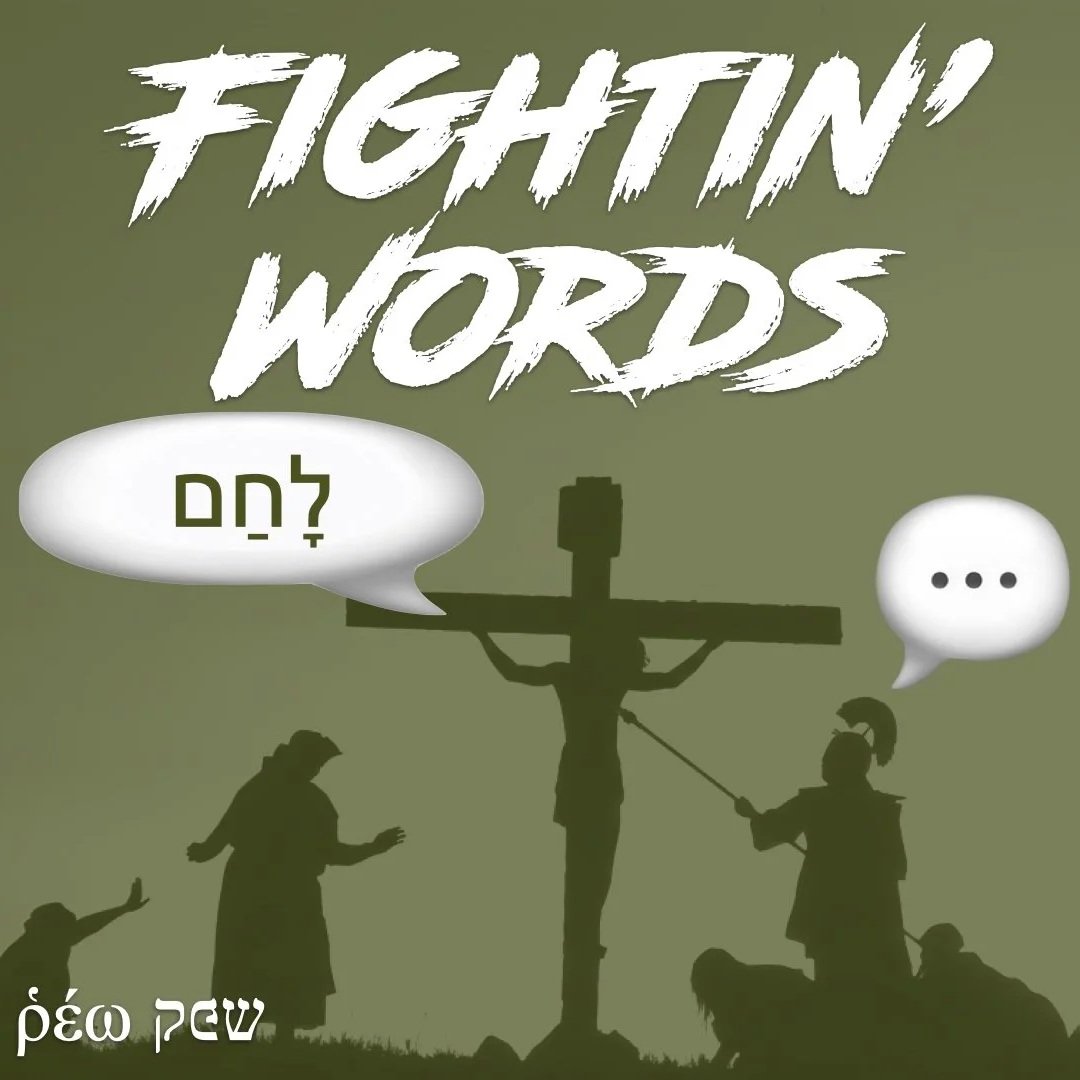
lāḥam
A three-consonant Hebrew root, L-H-M has a complex set of meanings that can infer both combat and consumption. As a noun it becomes milḥāmâ (H4421), that which devours. Although most often rendered “fight/ing,” it retains its alternate meaning, as in Deuteronomy 32:24; “they shall be wasted with hunger, and devoured (lāḥam) by plague.” A derived adjective, ḥāmaš (H2571), armed, is closely related to ḥōmeš (H2570), obese. The Hebrew word for fighter, lokhém (לוחם), never appears in the Hebrew Scriptures and has no Strong’s Concordance number.
Occurrences
There are only 18 references to fighting in Torah, the first five books of the Hebrew Bible. The first is placed on the lips of the Egyptians, who are afraid that, if milḥāmâ breaks out, then Joseph’s descendants may “join our enemies and lāḥam against us.” (Exodus 1:10) In Joshua, care is given to point out that YHWH is solely responsible for lāḥam, with chapter 10 being of particular interest for its repeated usage and ambiguous attribution; although framed by YHWH’s agency in vv.14, 25, and 42, several verses in between imply Israel fights. Other exemplary uses include;
Exodus 14:4 “YHWH will lāḥam for you, and you have only to be silent.”
Deuteronomy 20:10 “When you draw near to a city to lāḥam against it, offer terms of peace to it.”
Joshua 24:8 "the Amorites... lāḥam with you, and I gave them into your hand, and you took possession of their land, and I destroyed them before you."
Conclusion
It is noteworthy that fighting, lāḥam, has no scriptural form to imply the Israelite tradition tolerates its members being ‘fighters.’ Rather it is YHWH alone to whom this attribute is assigned, and members of Israel’s armies are never called lokhém. While this privileges a pacifist reading of armed service, it does not fully endorse one. Clearly the Israelites did engage in battle, even if the ordained nature of that activity is such that humanity is prohibited from employing on its own behalf.
More H4421
Exodus
14:25 "the Egyptians said, 'Let us flee from before Israel, for the LORD lāḥam for them against [us]"
17:8-10 "Amalek came and lāḥam with Israel... 9 So Moses said to Joshua, 'Choose for us ĕnôš (H582), and go out and fight with Amalek...' 10 So Joshua did as Moses told him, and lāḥam with Amalek"
* Numbers has 4 occurrences but none attach to Israel or YHWH.
Deuteronomy
1:30 “The LORD… will himself lāḥam for you"
1:41-42 “We have sinned against the LORD. We ourselves will go up and lāḥam, just as the LORD our God commanded us.’ And every one of you fastened on his weapons of war and thought it easy to go up into the hill country. 42 And the LORD said to [Moses], ‘Say to them, Do not go up or lāḥam, for I am not in your midst, lest you be defeated before your enemies.’
3:22 “it is the LORD your God who lāḥam for you.’
20:4 “the LORD your God is he who goes with you to lāḥam for you"
20:19 “When you besiege a city for a long time, lāḥam against it in order to take it, you shall not destroy its trees... Are the trees in the field human, that they should be besieged by you?"
Joshua
10:14 "the LORD lāḥam for Israel"
10:25 "Joshua said to them, 'Do not be afraid or dismayed; be strong and courageous. For thus the LORD will do to all your enemies against whom you lāḥam.'”
10:42 "Joshua captured all these kings and their land at one time because the LORD God of Israel lāḥam for Israel."
19:47 "the people of Dan went up and lāḥam against Leshem, and after capturing it and striking it with the sword they took possession of it and settled in it"
23:3, 10 "it is the LORD your God who has lāḥam for you."
24:11 "the leaders of Jericho lāḥam against you, and also the Amorites, the Perizzites, the Canaanites, the Hittites,