ADH: “Vet Sues Boshart Davis After Dustup”
On July 10, 2025, the Albany Democrat Herald published the following piece by Cody Mann.
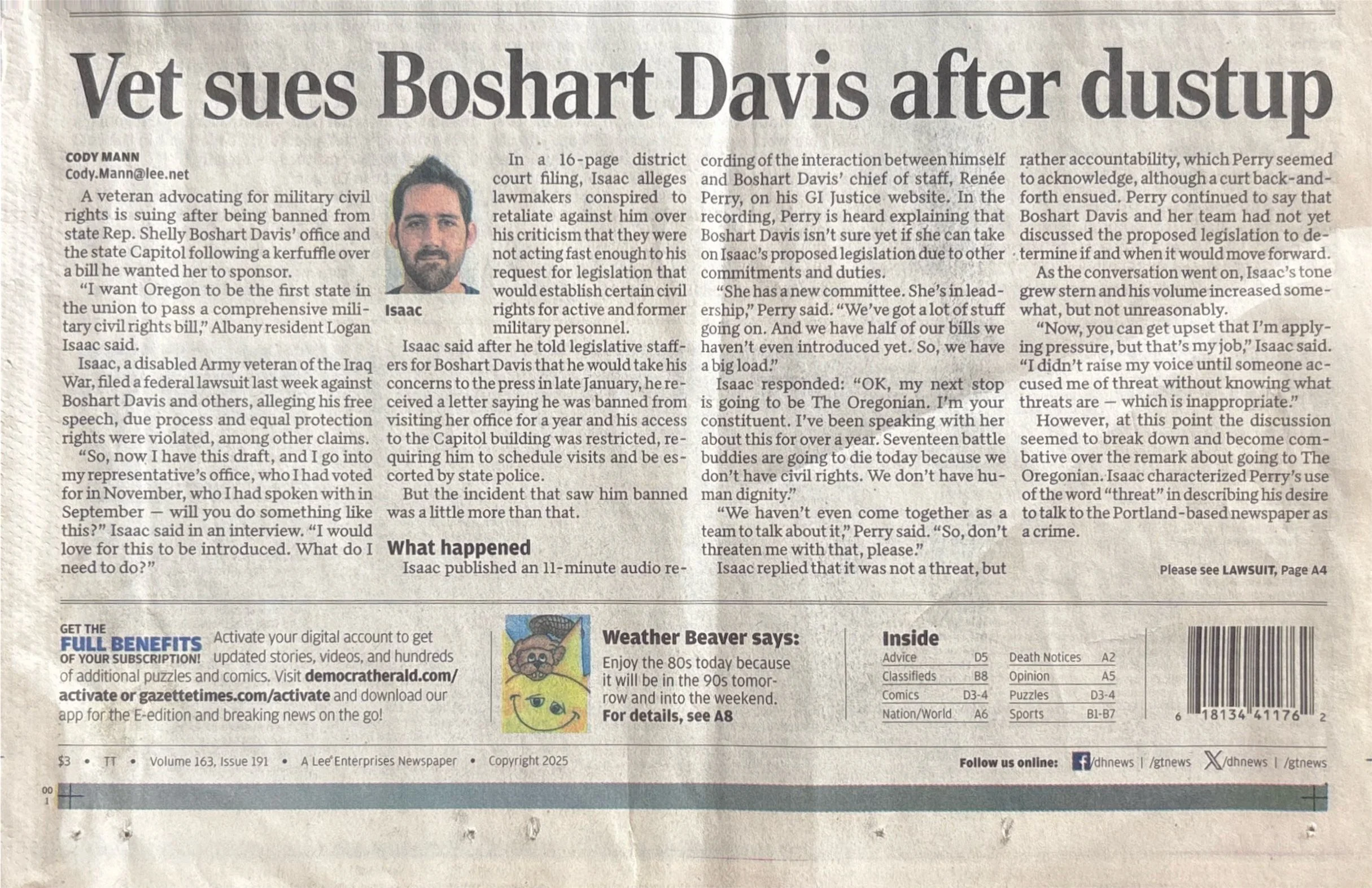
Vet sues Boshart Davis after dustup
By CODY MANN
A veteran advocating for military civil rights is suing after being banned from state Rep. Shelly Boshart Davis' office and the state Capitol following a kerfuffle over a bill he wanted her to sponsor.
"I want Oregon to be the first state in the union to pass a comprehensive military civil rights bill," Albany resident Logan Isaac said.
Isaac, a disabled Army veteran of the Iraq War, filed a federal lawsuit last week against Boshart Davis and others, alleging his free speech, due process and equal protection rights were violated, among other claims.
"So, now I have this draft, and I go into my representative's office, who I had voted for in November, who I had spoken with in September — will you do something like this?" Isaac said in an interview. "I would love for this to be introduced. What do I need to do?"
In a 16-page district court filing, Isaac alleges lawmakers conspired to retaliate against him over his criticism that they were not acting fast enough to his request for legislation that would establish certain civil rights for active and former military personnel.
Isaac said after he told legislative staffers for Boshart Davis that he would take his concerns to the press in late January, he received a letter saying he was banned from visiting her office for a year and his access to the Capitol building was restricted, requiring him to schedule visits and be escorted by state police.
But the incident that saw him banned was a little more than that.
What happened
Isaac published an 11-minute audio recording of the interaction between himself and Boshart Davis' chief of staff, Renée Perry, on his GI Justice website. In the recording, Perry is heard explaining that Boshart Davis isn't sure yet if she can take on Isaac's proposed legislation due to other commitments and duties.
"She has a new committee. She's in leadership," Perry said. "We've got a lot of stuff going on. And we have half of our bills we haven't even introduced yet. So, we have a big load."
Isaac responded: "OK, my next stop is going to be The Oregonian. I'm your constituent. I've been speaking with her about this for over a year. Seventeen battle buddies are going to die today because we don't have civil rights. We don't have human dignity."
"We haven't even come together as a team to talk about it," Perry said. "So, don't threaten me with that, please."
Isaac replied that it was not a threat, but rather accountability, which Perry seemed to acknowledge, although a curt back-and-forth ensued. Perry continued to say that Boshart Davis and her team had not yet discussed the proposed legislation to determine if and when it would move forward.
As the conversation went on, Isaac's tone grew stern and his volume increased somewhat, but not unreasonably.
"Now, you can get upset that I'm applying pressure, but that's my job," Isaac said. "I didn't raise my voice until someone accused me of threat without knowing what threats are — which is inappropriate."
However, at this point the discussion seemed to break down and become combative over the remark about going to The Oregonian. Isaac characterized Perry's use of the word "threat" in describing his desire to talk to the Portland-based newspaper as a crime.
Please see LAWSUIT, Page A4
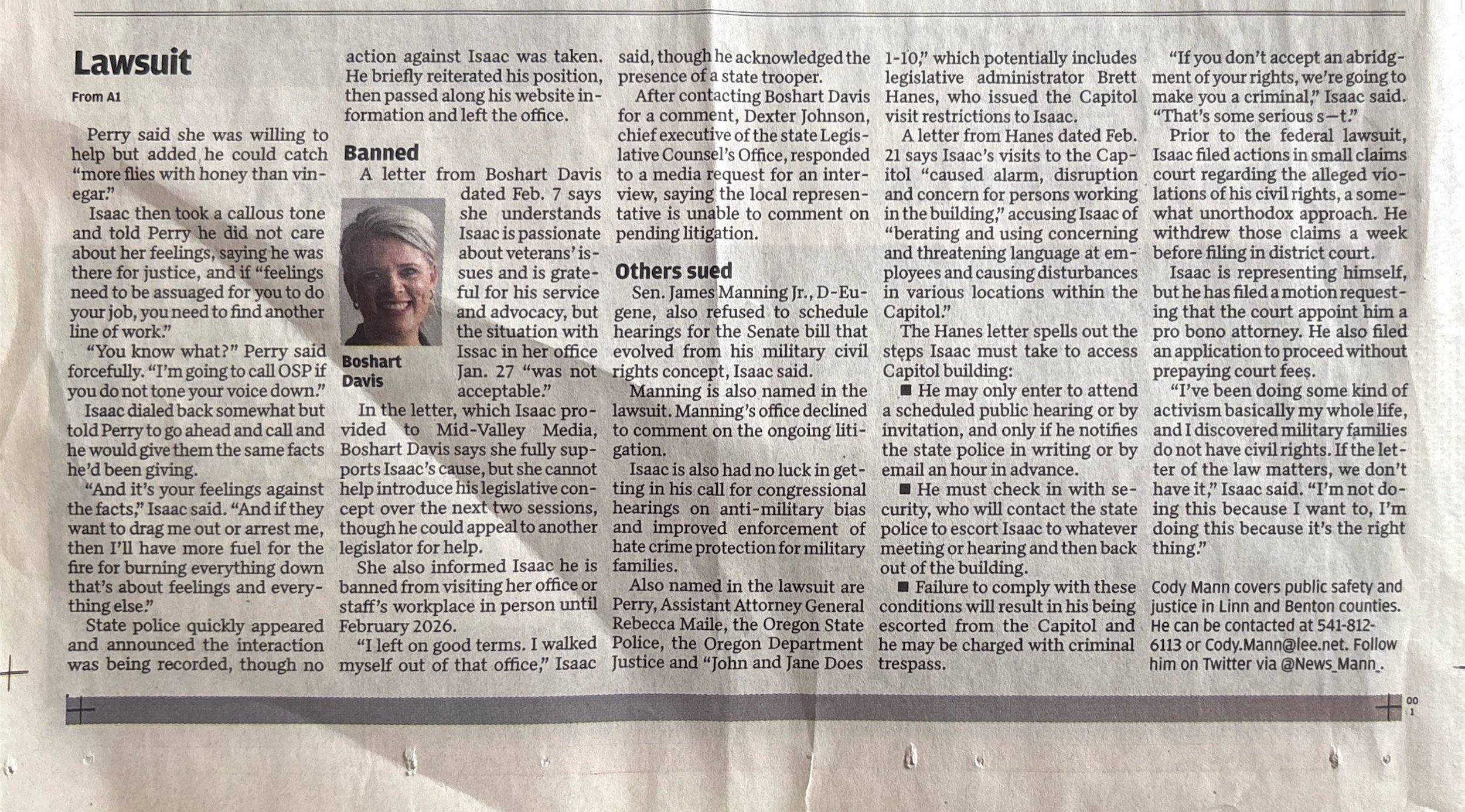
Lawsuit
From A1
Perry said she was willing to help but added, he could catch "more flies with honey than vinegar."
Isaac then took a callous tone and told Perry he did not care about her feelings, saying he was there for justice, and if "feelings need to be assuaged for you to do your job, you need to find another line of work."
"You know what?" Perry said forcefully. "I'm going to call OSP if you do not tone your voice down."
Isaac dialed back somewhat but told Perry to go ahead and call and he would give them the same facts he'd been giving.
"And it's your feelings against the facts," Isaac said. "And if they want to drag me out or arrest me, then I'll have more fuel for the fire for burning everything down that's about feelings and everything else."
State police quickly appeared and announced the interaction was being recorded, though no action against Isaac was taken. He briefly reiterated his position, then passed along his website information and left the office.
Banned
A letter from Boshart Davis dated Feb. 7 says she understands Isaac is passionate about veterans' issues and is grateful for his service and advocacy, but the situation with Isaac in her office Jan. 27 "was not acceptable."
In the letter, which Isaac provided to Mid-Valley Media, Boshart Davis says she fully supports Isaac's cause, but she cannot help introduce his legislative concept over the next two sessions, though he could appeal to another legislator for help.
She also informed Isaac he is banned from visiting her office or staff's workplace in person until February 2026.
"I left on good terms. I walked myself out of that office," Isaac said, though he acknowledged the presence of a state trooper.
After contacting Boshart Davis for a comment, Dexter Johnson, chief executive of the state Legislative Counsel's Office, responded to a media request for an interview, saying the local representative is unable to comment on pending litigation.
Others sued
Sen. James Manning Jr., D-Eugene, also refused to schedule hearings for the Senate bill that evolved from his military civil rights concept, Isaac said.
Manning is also named in the lawsuit. Manning's office declined to comment on the ongoing litigation.
Isaac is also had no luck in getting in his call for congressional hearings on anti-military bias and improved enforcement of hate crime protection for military families.
Also named in the lawsuit are Perry, Assistant Attorney General Rebecca Maile, the Oregon State Police, the Oregon Department of Justice and "John and Jane Does 1-10," which potentially includes legislative administrator Brett Hanes, who issued the Capitol visit restrictions to Isaac.
A letter from Hanes dated Feb. 21 says Isaac's visits to the Capitol "caused alarm, disruption and concern for persons working in the building," accusing Isaac of "berating and using concerning and threatening language at employees and causing disturbances in various locations within the Capitol."
The Hanes letter spells out the steps Isaac must take to access Capitol building:
He may only enter to attend a scheduled public hearing or by invitation, and only if he notifies the state police in writing or by email an hour in advance.
He must check in with security, who will contact the state police to escort Isaac to whatever meeting or hearing and then back out of the building.
Failure to comply with these conditions will result in his being escorted from the Capitol and he may be charged with criminal trespass.
"If you don't accept an abridgment of your rights, we're going to make you a criminal," Isaac said. "That's some serious s—t."
Prior to the federal lawsuit, Isaac filed actions in small claims court regarding the alleged violations of his civil rights, a somewhat unorthodox approach. He withdrew those claims a week before filing in district court.
Isaac is representing himself, but he has filed a motion requesting that the court appoint him a pro bono attorney. He also filed an application to proceed without prepaying court fees.
"I've been doing some kind of activism basically my whole life, and I discovered military families do not have civil rights. If the letter of the law matters, we don't have it," Isaac said. "I'm not doing this because I want to, I'm doing this because it's the right thing."