GruntGod 2.11.3: The Women Who Founded Your Church
…and Got Written Out of the Org Chart
This is drawn from the revision of the Joan chapter in the second edition of God Is a Grunt.
Lydia and Priscilla deserve more than a passing thought from Christian leaders.
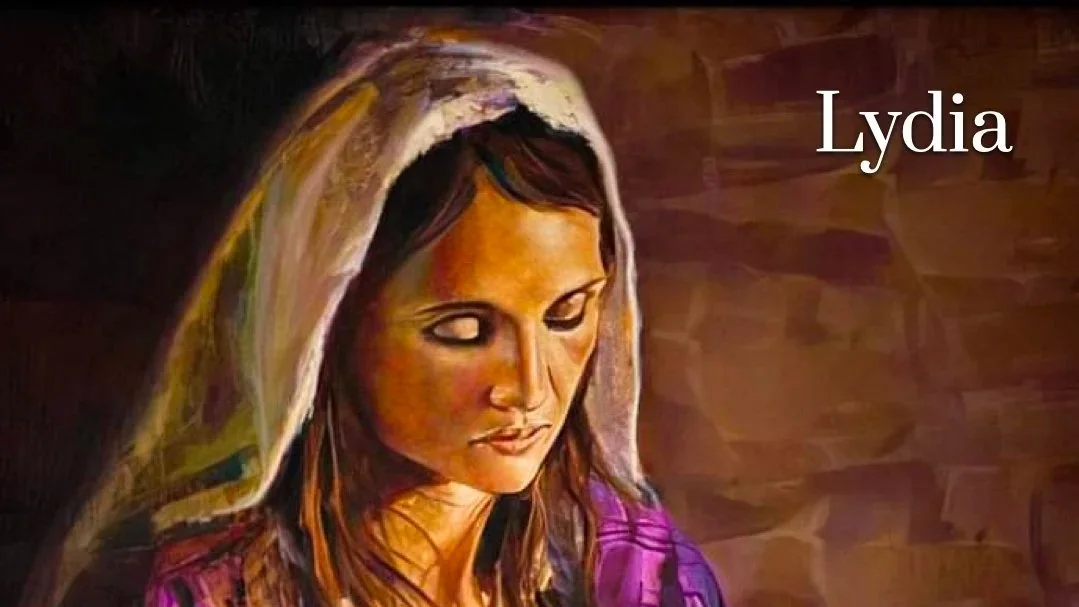
Read more about Lydia at https://pewpewhq.com/blog/lydia-purple-seller.
Start with Lydia, in Acts 16:14. She's identified as a porphyropōlis (G4211) — a "seller of purple," meaning she dealt in the imperial dye trade, one of the most tightly regulated and lucrative markets in the Roman world. That occupation alone tells you she was moving in wealthy, connected circles; purple dye was a luxury good tied closely to imperial status. When she hears Psaul and Silas preach, she has her whole household baptized and essentially conscripts the missionaries into using her home as their base of operations in Philippi (Acts 16:15). Some readers assume she inherited her status from a deceased husband, since no husband is mentioned. That's possible, but it isn't the only reading available, and I think it's worth naming an alternative the text doesn't rule out: Philippi was a Roman colony substantially populated by veterans given land grants after decades of civil war. It's entirely plausible that Lydia's trade, her connections, and her citizenship came down to her through a veteran father transitioning out of military service into commerce — which would mean the first church in Europe was headquartered in a veteran family's household, hosted by that veteran's daughter. I can't prove that reading. But it fits the demographic reality of Philippi better than most commentaries acknowledge.
Then there's Priscilla, always named alongside her husband Aquila but frequently named first — which ancient naming conventions treated as significant, usually indicating the more prominent or more socially notable of a pair. Psaul meets them in Corinth after they were expelled from Rome under Claudius's edict against Jews (Acts 18:2). He calls them synergos (G4904) — "co-workers," the same term he uses for his closest male collaborators, not a diminished or gendered variant of it. Their house becomes the meeting place for the church in Corinth, and later in Ephesus, where Priscilla and Aquila together take aside a gifted but incompletely-taught preacher named Apollos and "explain the Way of God more accurately" to him (Acts 18:26). That verb — more accurately — is doing real work: Apollos wasn't a novice, he was already an effective public teacher, and Priscilla is credited (alongside her husband) with correcting a trained preacher's theology.

That level of authority is exactly why, historically, some scholars floated the theory that Priscilla was the actual author of the epistle to the Hebrews — a document whose author is anonymous and whose Greek is some of the most sophisticated in the New Testament. That theory has largely fallen out of favor in current scholarship (Apollos himself is now a more commonly proposed candidate), and I don't want to overstate a minority position as though it were settled. But the fact that credible scholars could look at the level of theological sophistication in Hebrews and think "this could be Priscilla" tells you something about how seriously her teaching authority was taken, independent of whether the theory is ultimately correct.
None of this required the church to invent something new. Lydia and Priscilla weren't exceptions the early church tolerated. They were the infrastructure — the hosts, the funders, the teachers — that made the early Christian movement functionally possible in Philippi, Corinth, and Ephesus. The "org chart" of the early church, if you actually draw it from Acts and the epistles rather than from later assumption, runs straight through their households.